The positions in a birth chart are accurate to a fraction of a degree and can be checked against NASA. The interpretation of them has never been shown to work under controlled conditions. Both...
The RubyAstro TeamPublished September 27, 2026Dates checked September 27, 20264 min read
How Accurate Is a Birth Chart? An Honest Answer
The short answerThe positions in a birth chart are accurate to a fraction of a degree and can be checked against NASA. The interpretation of them has never been shown to work under controlled conditions. Both halves of that sentence are true and most writing on the subject leaves one of them out.
The astronomy is not in question
Every position in a chart comes from an ephemeris, and modern ephemerides are derived from the same orbital models that land spacecraft. The Sun's position at your birth is known to better than an arcsecond. Nobody disputes this, including people who dispute everything else about astrology.
So when a chart says your Moon was at 14 degrees of Taurus, that is a fact about the solar system, not a claim.
The interpretation has not held up
This is the part worth being straight about. The best-known test, by Shawn Carlson and published in Nature in 1985, had astrologers match charts to personality profiles and found they performed at chance. Later reviews of the literature have reached similar conclusions. There is no measured effect.
That does not mean everybody who uses astrology is wasting their time, and it does not mean the people who find it useful are fools. It means the mechanism claimed has not been demonstrated, and a site that tells you otherwise is selling something.
Why people find it useful anyway
A chart is a structured set of prompts about yourself, delivered in the second person, that you did not write. That turns out to be a genuinely effective way to think about things you have been avoiding, and it does not require the astrology to be causal for the reflection to be real.
The honest version of the pitch is: this is an interesting and very old framework for thinking about a life, with a vocabulary rich enough to describe things ordinary language fumbles. That claim is defensible. The claim that the planets are doing it is not.
Where the accuracy actually breaks
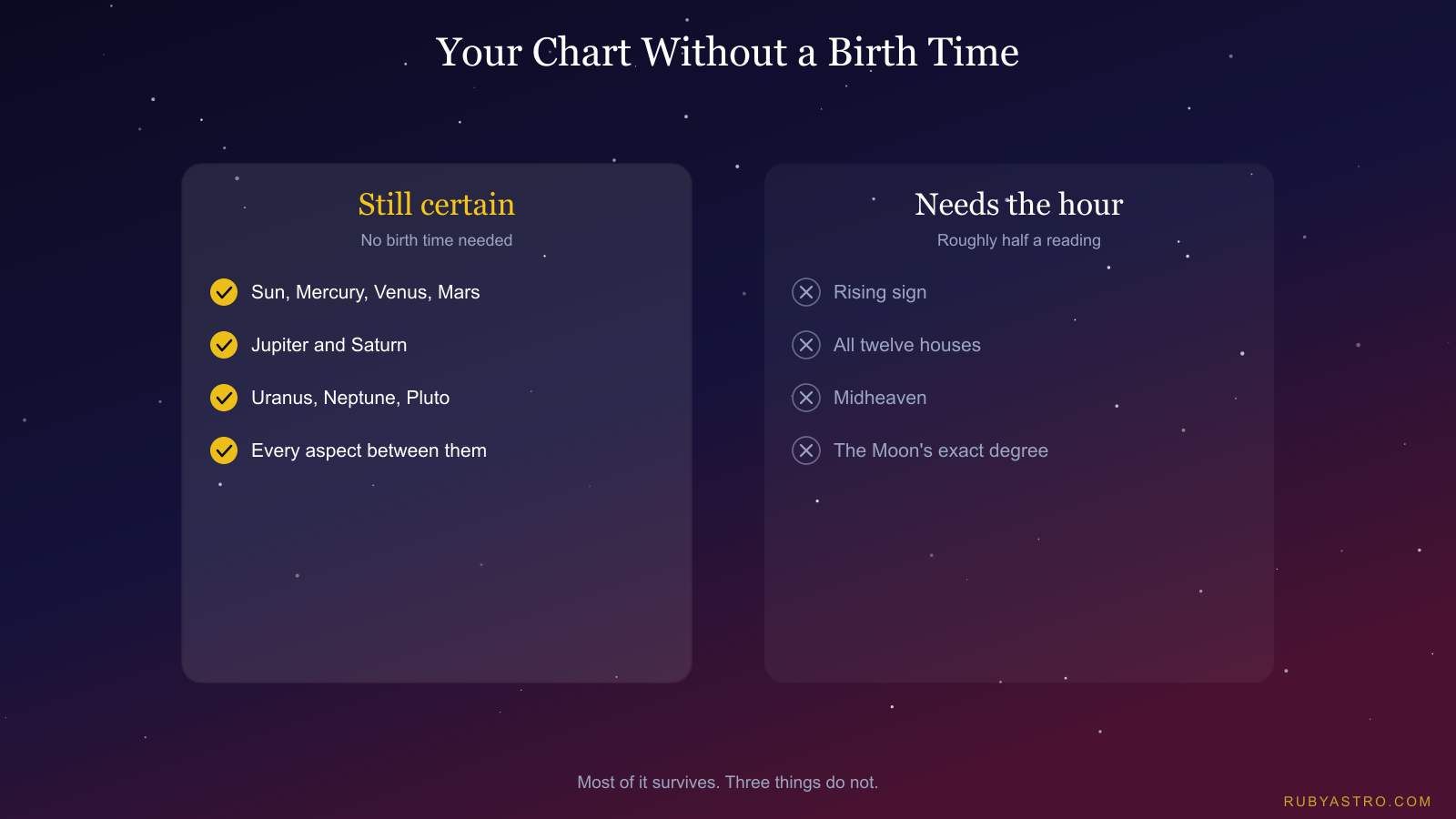
Practically, the weak point is almost never the astronomy. It is the birth time. A time recorded to the nearest quarter hour, rounded by a tired nurse, or remembered by a parent decades later can move the rising sign by a whole sign and shift every house in the chart.
If a chart reading feels wrong in a way you cannot place, check the time before you blame the technique.
What is checkable and what is not
Claim
Status
Planet positions at your birth
Checkable, accurate to a fraction of a degree
The dates of eclipses, retrogrades and ingresses
Checkable, accurate to the minute
Your rising sign, given an accurate time
Checkable arithmetic
That a chart describes your personality
Tested and not supported
That transits predict events
Not demonstrated
That a chart is useful to think with
A matter of experience, and widely reported
What a careful claim sounds like
Compare two sentences. The first: your Saturn return at 29 will bring a career crisis. The second: Saturn returns to its birth position at about 29 and a half, a period traditionally associated with structures being tested, and it is worth asking yourself now which of yours would not survive that.
The first is a prediction with no support. The second is a date, a tradition, and a question. Both come from the same astrology and only one of them is honest, which is roughly the whole editorial position of this site.
What people get wrong about this
Treating the astronomy and the interpretation as one claim. The first is exact and the second is unsupported, and conflating them helps nobody.
Citing the Carlson study as proof astrology is worthless. It tested one specific claim under one protocol and found chance performance, which is narrower than it is usually reported as.
Dismissing the usefulness because the mechanism is unproven. People find structured self-reflection useful and that does not require planets to be causing it.
Blaming the technique when a reading misses, before checking whether the birth time is right.
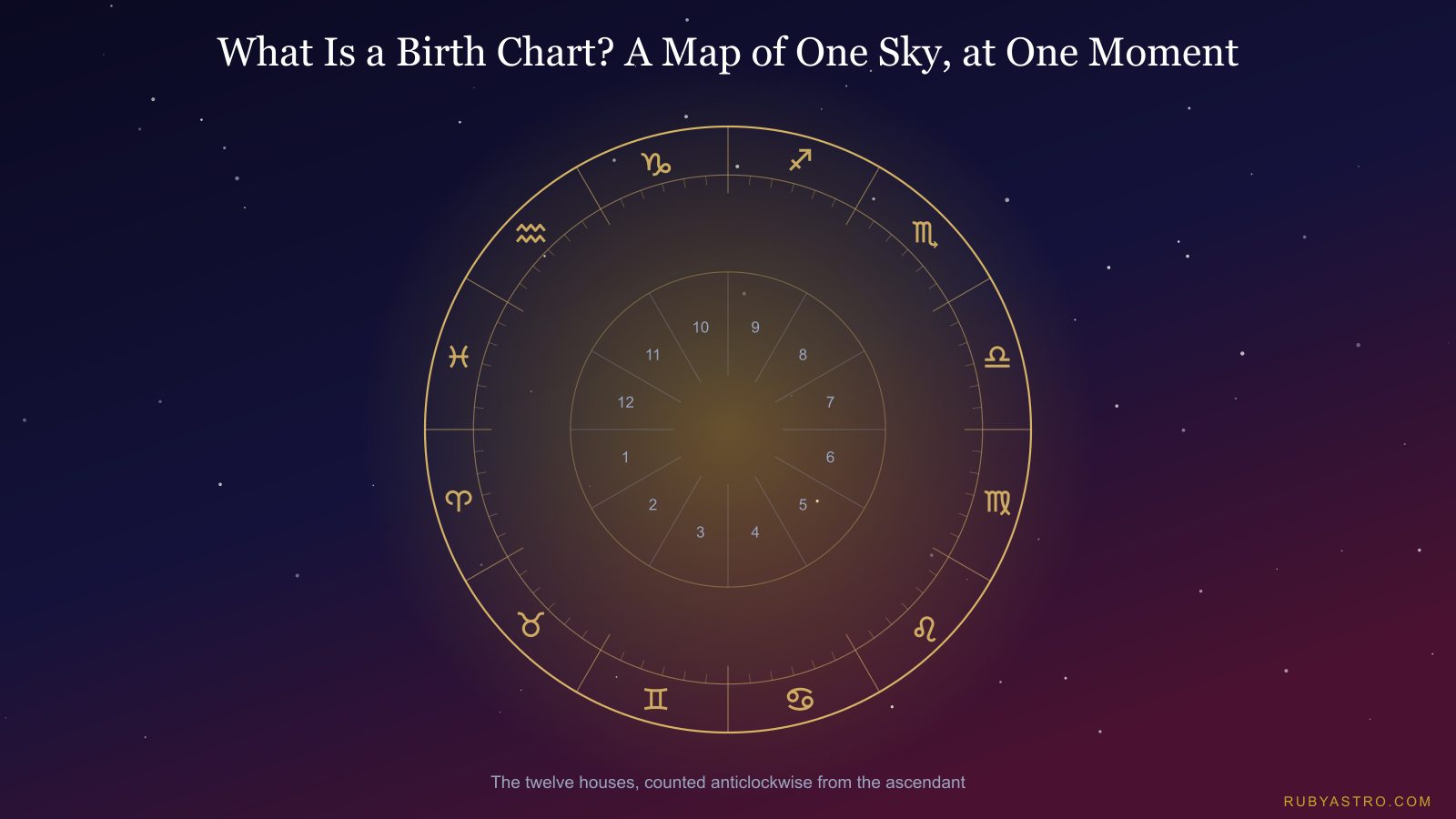
What a birth chart is and is notA birth chart is an accurate diagram of where the planets were at a moment, calculated from real astronomy. That part is not in dispute. What is in dispute, and what no controlled study has supported, is that those positions describe a personality or predict a life. Treat it as a structured way of thinking about yourself that happens to use real sky positions as its scaffolding, which is an honest description and still a useful thing. Nothing here should stand in for medical, legal or financial advice.
Everything on this page is general by necessity. A reading built from your own date, time and place is the version that names your placements rather than describing the categories they fall into. If you do not know your birth time, this covers how to find it.
Questions people ask
Is astrology scientifically proven?
No. The positions are astronomy and are exact; the interpretation has not held up under controlled testing, including the 1985 Carlson study in Nature.
Are birth chart calculations accurate?
Yes. They come from the same ephemerides used for spacecraft navigation.
What makes a chart reading go wrong?
An inaccurate birth time, far more often than anything else. An hour of error can change the rising sign.
RubyAstro writes about astrology for reflection and self-understanding. Nothing here is medical, legal or financial advice, and none of it is a prediction of events. Read our full disclaimer.
 Finding Your Birth Time