What Your Chart Still Tells You Without a Birth Time
Most of your chart does not need the hour. Every planet except the Moon stays in the same sign all day, and so does every aspect between them. Here is exactly what you keep, what you lose, and what to do about the gap.
The RubyAstro TeamPublished October 6, 2026Dates checked October 6, 20267 min read
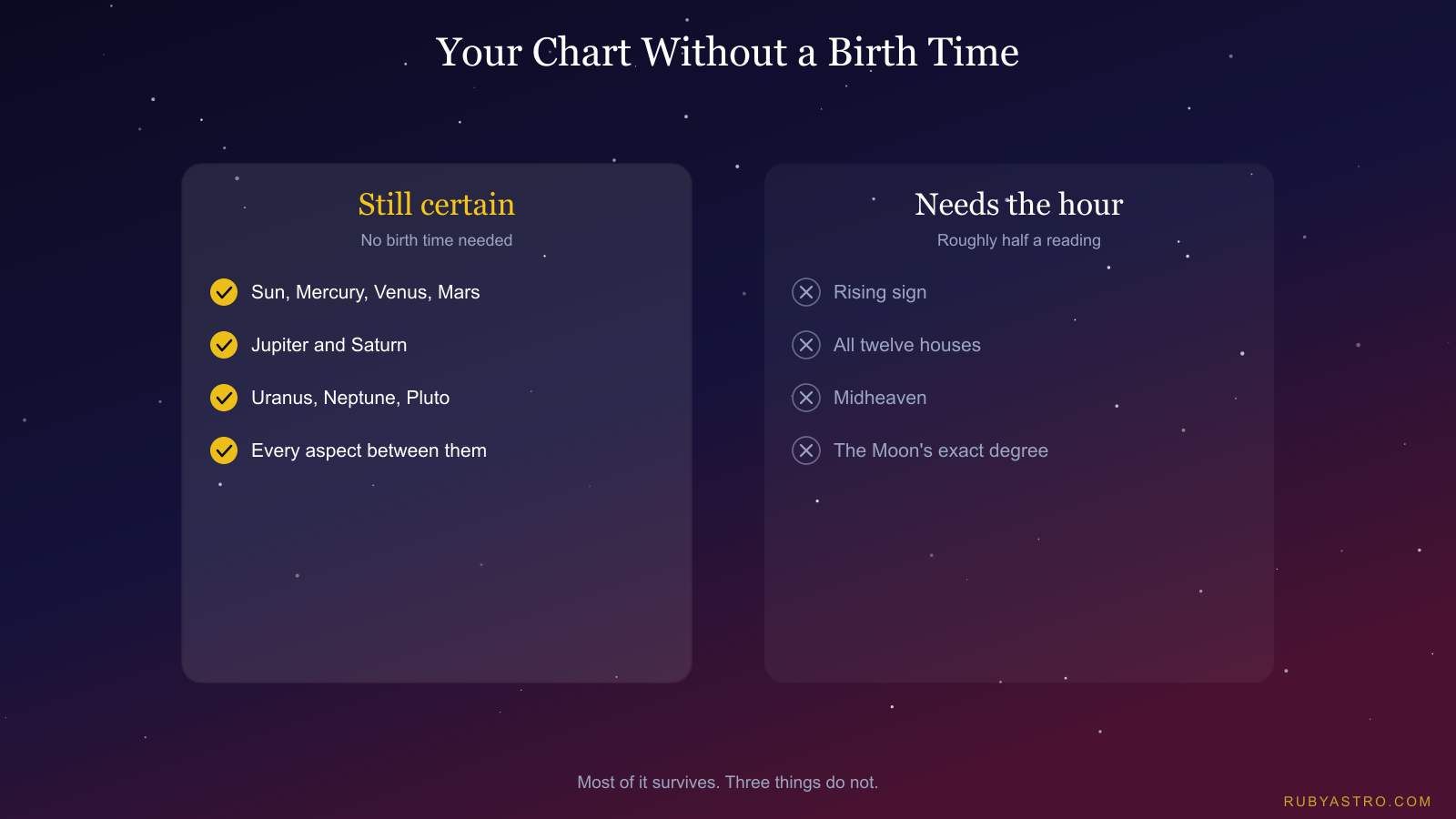
Without an hour you lose the rising sign, the houses and an exact Moon. Everything else in the chart is still solid.
The short answerWithout a birth time you keep every planet's sign, every aspect between them, and the whole pattern of your chart's shape. You lose the rising sign, the twelve houses, the midheaven, and the Moon's exact degree. That is a real loss, but it is roughly half the chart rather than all of it, and nobody tells you that because conceding a limit does not sell.
This page exists because the birth-time guides on this site send people to go and find their hour, and a good number of them will not find it. If that is you, you have not been locked out of astrology. You have been handed a slightly smaller version of it.
What you keep
The Sun moves about one degree a day. Mercury, Venus and Mars move less than two. Jupiter and Saturn barely move at all in twenty-four hours, and Uranus, Neptune and Pluto move so slowly that a whole week makes no visible difference. So every one of those planets is in the same sign at midnight as it is at midnight the following night.
That means the following is certain, with no birth time at all:
Your Sun sign, Mercury sign, Venus sign and Mars sign. The four that most readings spend most of their time on.
Jupiter and Saturn by sign, which carry the long-cycle story.
Uranus, Neptune and Pluto by sign, which you share with everyone born around the same years.
Every aspect between those planets. If your Venus squares your Saturn, it does so all day.
The overall shape: whether your planets are bunched into one part of the zodiac or spread across it, which is one of the first things a working astrologer actually looks at.
The aspects are the part people underrateAn aspect is the angle between two planets, and it is where most of the repeating patterns in a life show up. A Venus square Saturn says something specific about how affection and worth got tangled together, and it says it whether or not you know what time the delivery room clock read. Readings that lean on aspects rather than houses lose very little without an hour.
What you lose
Three things, and they are not small.
What a birth time adds to a chart, and what it costs to go without it
What
Needs the hour because
What its absence costs
Rising sign
The horizon moves through all twelve signs every twenty-four hours, about one sign every two hours
The whole frame of the chart, and the first thing most readings lead with
The twelve houses
They are built outward from the rising degree
Which area of life each planet operates in. Your Mars is certain; whether it is working on your career or your home is not
Midheaven
It is the degree directly overhead, which changes every four minutes
The clearest single indicator of public role and direction
Moon degree
The Moon moves twelve to fifteen degrees a day, about half a sign
Usually only the degree, not the sign. If you were born on a day the Moon changed sign, you lose the sign too
The Moon is the one worth checking rather than assuming. It changes sign every two and a half days, so most of the time a day is comfortably inside one sign. But if your birthday happens to be a day it crossed over, your Moon could be either of two signs, and that is worth knowing before you read anything about it.
The noon chart convention
When the hour is unknown, the usual practice is to cast the chart for 12:00 PM. Not because noon is likely, but because it is the middle, which keeps the Moon within about six degrees of wherever it really was and keeps every other planet exactly right.
The thing to understand about a noon chart is that its houses are decoration. A chart calculator will draw them, label them one to twelve, and present them with the same confidence as everything else. They are meaningless. If you are reading a noon chart, read the planets, read the signs, read the aspects, and ignore the wheel's divisions entirely.
The mistake I see most often is somebody who has read their noon chart's houses for years and built a whole self-understanding on them. It is always awkward to unpick, and it is entirely the calculator's fault for drawing them without a warning.
Narrowing it down without the certificate
You very rarely need the exact minute. You need a window small enough to settle the rising sign, which means about two hours.
Ask whoever was there. Not for a time, which nobody remembers, but for a story. Was it before breakfast? Did your father miss work that day or not? Was it dark outside?
Look for the hour written somewhere other than the certificate: a baby book, a christening record, a newspaper announcement, a hospital bracelet in a box somewhere.
Ask the hospital for your own delivery records. These often carry a time when the certificate does not, and you have a right to them.
If you get a window rather than a time, say so to whoever reads your chart. A good astrologer can work with 'sometime in the afternoon' and will tell you which conclusions are safe and which are not.
Rectification is not a reconstruction of a factRectification works backwards from events you can date to find the birth time that best fits them. Done well it is genuinely skilful. But it produces an estimate that depends on the events you chose and the technique the astrologer prefers, and two careful practitioners can arrive at different answers. Anyone who hands you a rectified time to the minute without saying it is an estimate is overselling it.
What to do now
If you have a window of a couple of hours, that is usually enough. If you have nothing at all, read your chart for its planets and its aspects, which is a great deal, and leave the houses alone until you have something better. The state-by-state guides cover how to ask for the record that carries the hour, and the daylight saving page covers the other way an American birth time goes wrong, which is having one that is quietly an hour out.
Questions people ask
Can I get a birth chart without a birth time?
Yes, and most of it will be correct. Every planet except the Moon stays in the same sign for the whole day, so your Sun, Mercury, Venus, Mars, Jupiter, Saturn and the outer planets are all certain. What you cannot have is the rising sign, the house positions, and an exact Moon degree.
How much of a chart needs the birth time?
Roughly speaking, the houses and the angles, which is about half of what a full reading discusses. The planets, their signs and the aspects between them are all independent of the hour.
What is a noon chart?
A chart cast for 12:00 PM on your birthday, used as a convention when the time is unknown. It puts the Moon within about six degrees of its true position and makes the planetary placements usable. The houses in a noon chart mean nothing and should be ignored.
Can an astrologer work out my birth time?
Sometimes, by rectification: working backwards from events you can date to find the time that fits them. It is skilled work rather than guesswork, but the result is an estimate and should be described as one.
Is a reading worth doing without a birth time?
It depends what you want from it. For character, patterns and the aspects you keep repeating, yes. For questions that are fundamentally about timing or about which area of life something lands in, the hour does real work and its absence shows.
RubyAstro writes about astrology for reflection and self-understanding. Nothing here is medical, legal or financial advice, and none of it is a prediction of events. Read our full disclaimer.
 Finding Your Birth Time