Read a chart in four passes: the Big Three first, then which planets sit in which houses, then the aspects between them, then the chart as a whole. Most people fail at charts because they start...
The RubyAstro TeamPublished October 21, 2026Dates checked October 21, 20265 min read
How to Read a Birth Chart, in Four Passes
The short answerRead a chart in four passes: the Big Three first, then which planets sit in which houses, then the aspects between them, then the chart as a whole. Most people fail at charts because they start with the hardest layer, which is aspects, before knowing where anything is.
The order
Almost every beginner opens a chart and immediately starts hunting for aspects, which is the layer that needs the most context and gives the least on its own. The order below works because each pass gives you the information the next one needs.
Nobody reads a chart in one go. A chart has about ten bodies, twelve houses, twelve signs and dozens of aspects, and holding all of that at once is not a skill anybody has. Four passes is how it is actually done.
Pass one: the Big Three
Sun, Moon and rising sign. The Sun is what you are consciously trying to become, the Moon is what you need when nobody is watching, and the rising sign is the way you come across before you have said anything. Between them they cover most of what people recognise about themselves, which is why they are the three everybody learns first.
If the three agree, you get a person who reads as straightforwardly their sign. If they disagree, and they usually do, the disagreement is the interesting part and it is the reason Sun sign horoscopes so often miss.
Pass two: planets in houses
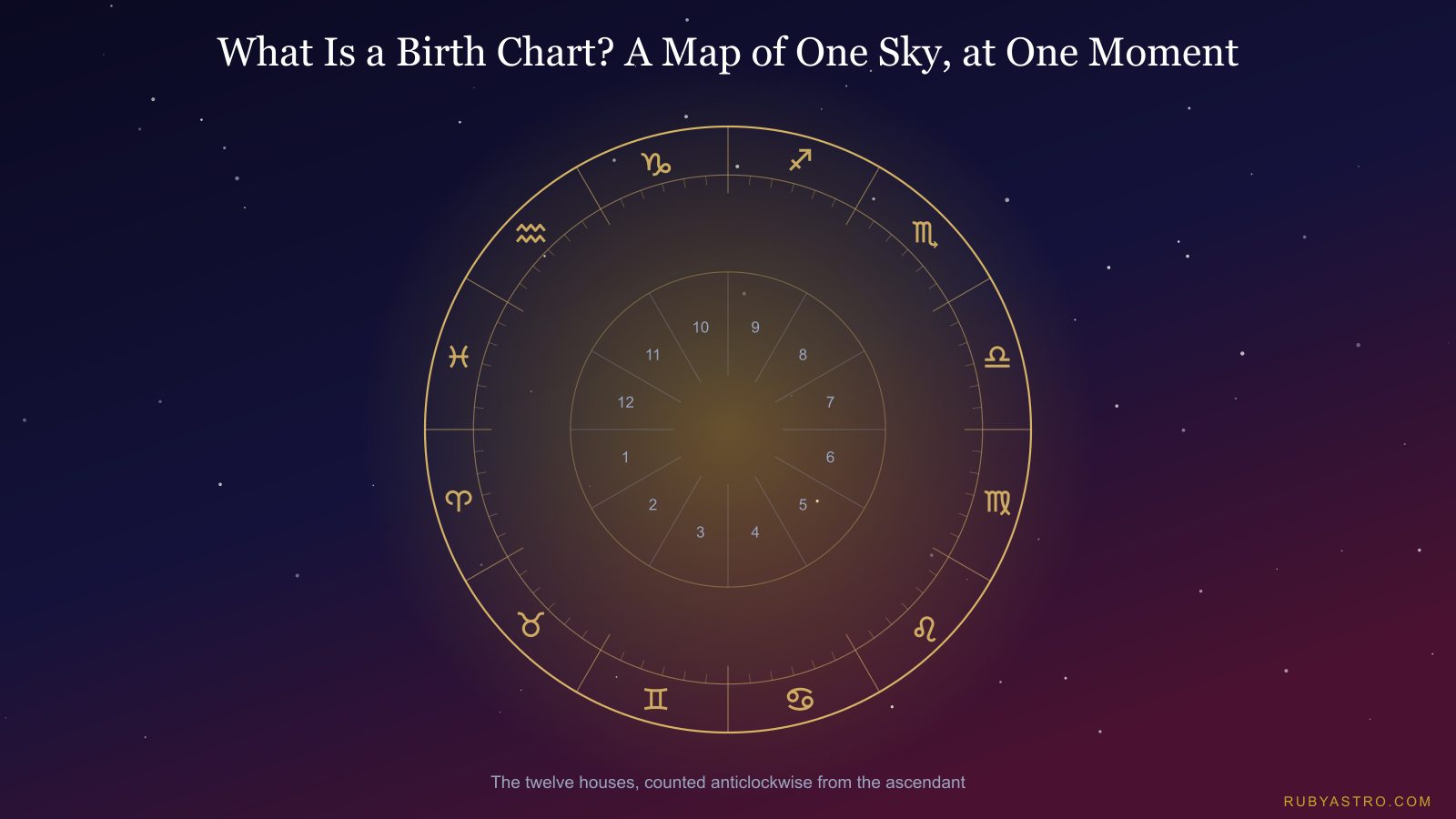
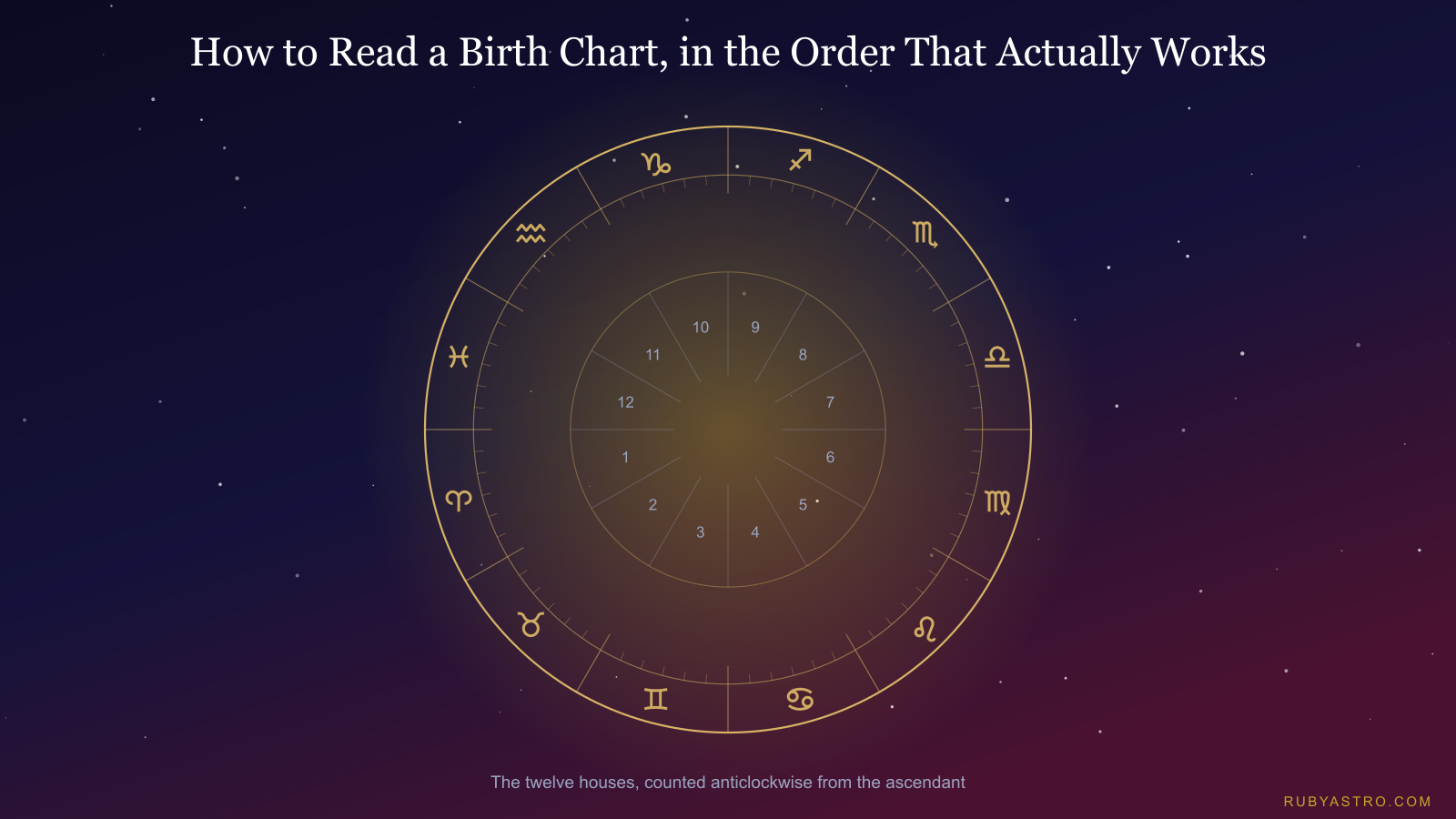
Now find where each planet sits. The sign tells you how a planet behaves; the house tells you where in life it does it. Mars in Aries is direct and quick either way, but Mars in the 6th house spends that on daily work and Mars in the 7th spends it on one other person.
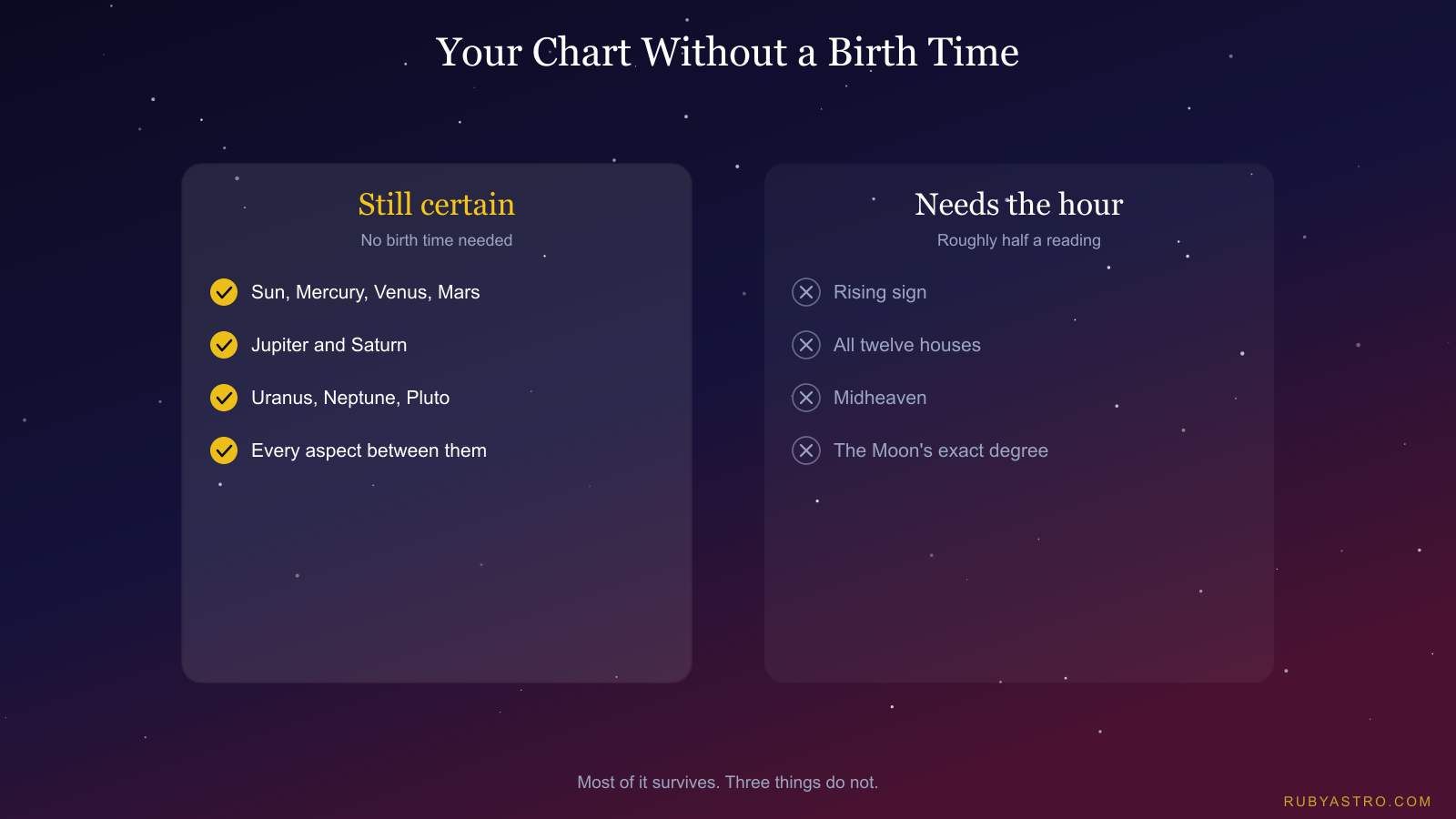
Houses need a birth time. This is the pass that quietly fails for anybody working from a date alone, and it is the pass that makes a chart feel personal rather than generic.
Pass three: aspects
Aspects are the angles between planets, and they say which parts of the chart are talking to each other. A conjunction fuses two things, an opposition stretches them apart, a square makes them grind, a trine lets them flow and a sextile offers an opportunity that has to be taken up.
Start with the tight ones. An aspect within two degrees of exact does far more work than one at seven, and a beginner who reads every aspect in a chart ends up with a description that fits everybody.
Pass four: the shape of the whole
Stand back. Is everything crowded into one part of the wheel or spread evenly? Are there four planets in one sign? Is one element missing entirely? These whole-chart features often say more than any single placement, and they are invisible if you never stop looking at details.
This is also where you notice what is not there. An empty house is not a problem, and a missing element usually shows up as something a person has had to build deliberately rather than something they lack.
The four passes, and what each one answers
Pass
What you look at
The question it answers
One
Sun, Moon, rising
Who is this, broadly
Two
Planets in houses
Where in life does each thing happen
Three
Aspects, tightest first
Which parts are in conversation
Four
Shape, elements, empty space
What is the overall pattern
A worked example
Take a chart with Sun in Capricorn, Moon in Leo, Scorpio rising. Pass one already has a tension: a person aiming at respect and competence, needing warmth and recognition, meeting the world guardedly. Those three do not agree, and that disagreement is the person.
Pass two: say Mars, the traditional ruler of Scorpio rising, sits in the 10th house. Now the chart is pointed at career, and the guarded first impression is in service of something public. Pass three: if that Mars squares the Leo Moon, the drive for standing is in direct conflict with the need to be liked, which is a specific and recognisable problem.
Four sentences, three passes, and nothing in it required memorising anything beyond what the pieces mean.
What people get wrong about this
Starting with aspects. They need the most context and give the least on their own, and a beginner who starts there produces a reading that fits everybody.
Reading every aspect in the chart. Thirty aspects at every orb describes nobody. Take the ones inside two degrees first and ignore the rest until those make sense.
Treating the Sun sign as the chart. It is one of roughly forty pieces of information and it is the least personal of them.
Looking up each placement separately and never combining them. A chart is a set of relationships, and a list of lookups is not a reading.
This needs your birth timeThe rising sign changes completely every two hours and moves a full degree every four minutes, so everything built on it, which is every house in the chart, needs an accurate time. Here is how to find yours, including which record to ask your state for and which one leaves the hour off.
Everything on this page is general by necessity. A reading built from your own date, time and place is the version that names your placements rather than describing the categories they fall into. If you do not know your birth time, this covers how to find it.
Questions people ask
Where do I start with a birth chart?
With the Big Three: Sun, Moon and rising sign. They cover most of what people recognise and they give you the context the rest of the chart needs.
Do I need my birth time to read a chart?
For the Sun and most planet signs, no. For the rising sign, the houses and the Moon on a fast day, yes.
How long does it take to learn?
The four passes above can be followed on day one. Reading a chart fluently takes a long time, mostly because it is a vocabulary problem rather than a technique problem.
RubyAstro writes about astrology for reflection and self-understanding. Nothing here is medical, legal or financial advice, and none of it is a prediction of events. Read our full disclaimer.
 Finding Your Birth Time