Daylight Saving and Your Birth Chart: The American Problem
If you were born in the US between 1945 and 1991, there is a real chance your birth time was recorded under a daylight saving rule your chart calculator does not know about. Here is how to check.
The RubyAstro TeamPublished September 18, 2026Dates checked September 18, 20267 min read
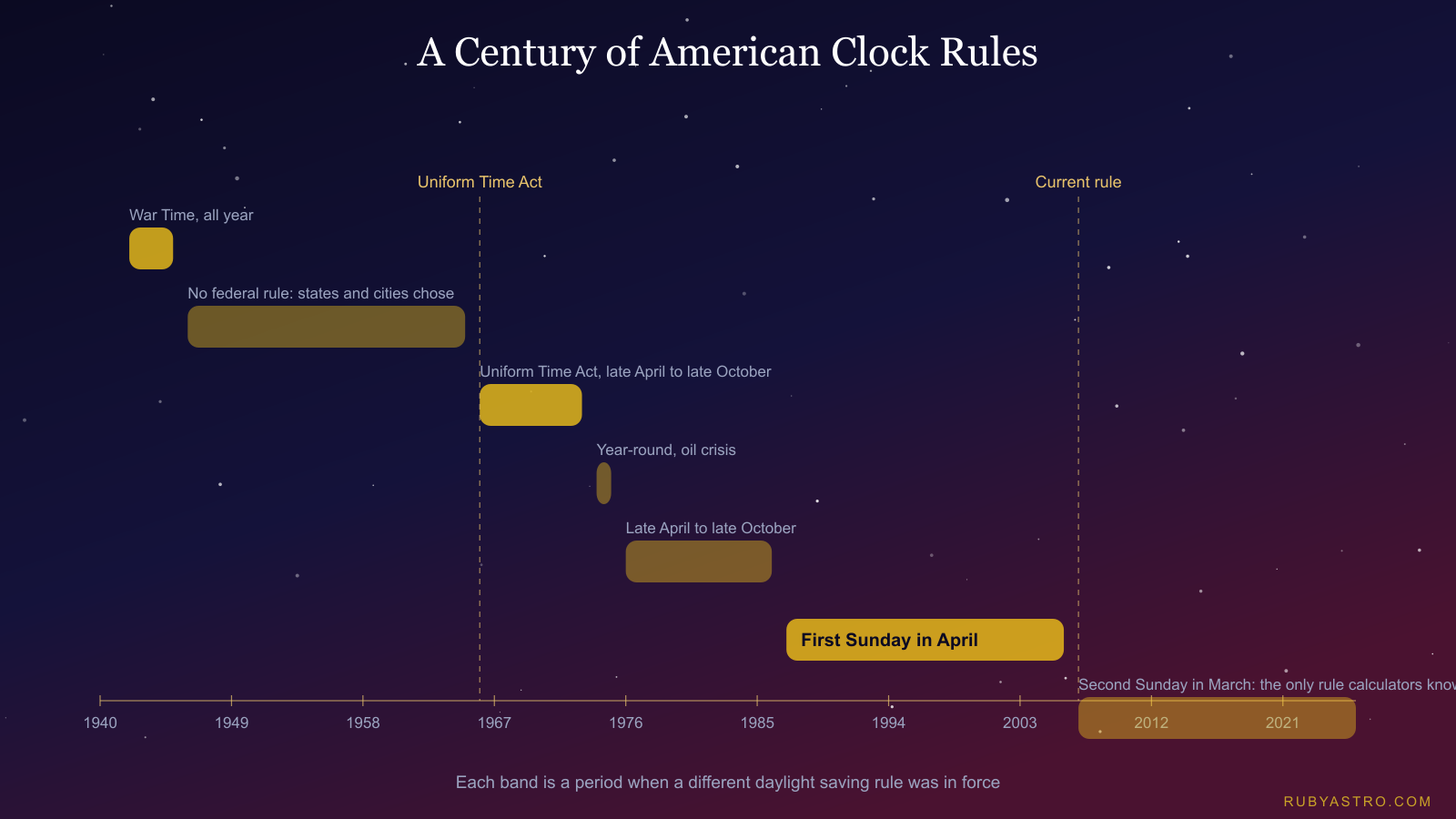
Four separate federal rules governed American clocks between 1942 and today, and most chart calculators only know the current one.
The short answerIf you were born in the United States between 1945 and 1991, your birth time may have been recorded under a daylight saving rule that free chart calculators do not apply correctly. The error is one hour, which moves your rising sign by about half a sign and can shift every house in your chart. Checking takes about two minutes.
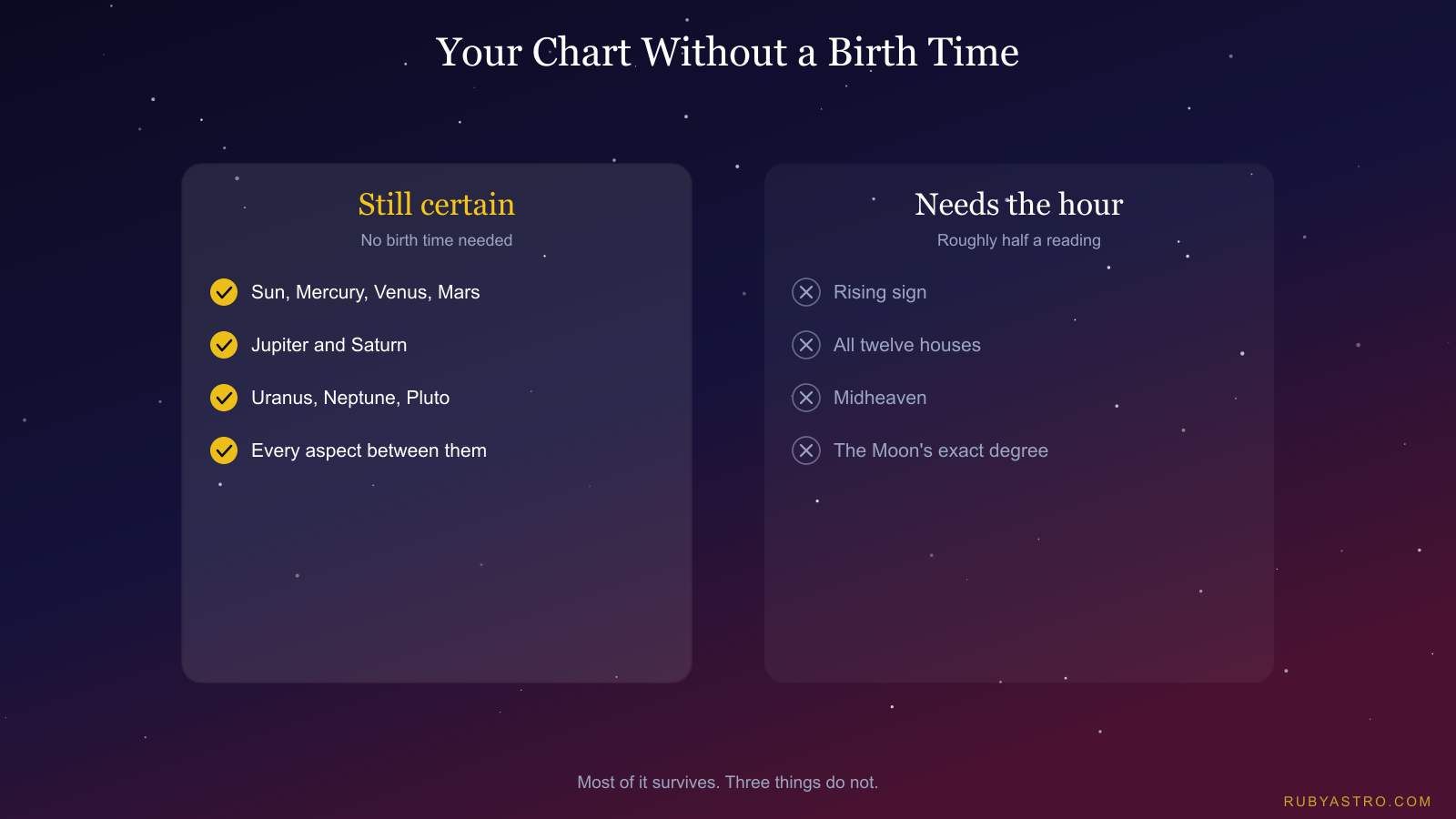
Most people who tell me their chart feels wrong have a perfectly good chart. What they have is a birth time that was entered as though American clocks have always worked the way they work now. They have not.
Why one hour matters so much
The rising sign is the degree of the zodiac coming over the horizon at the moment you were born. The earth turns through all 360 degrees in roughly 24 hours, which works out at about one degree every four minutes.
So an hour of error moves the rising degree by about fifteen degrees. Half a sign. If your birth time sits anywhere near a sign boundary, an hour is the difference between a Virgo rising and a Libra rising, and between a chart that describes you and one that does not.
It also rotates the houses. Your Sun can move from the tenth house to the ninth, which changes a career story into a travel and belief story. Nothing about the planets changes. Everything about where they live changes.
The four rules that governed American clocks
This is the part no astrology site publishes, and it is the whole reason the error happens. The United States has not had one consistent daylight saving rule in living memory. It has had four.
United States daylight saving rules by period, and what each one means for a birth time
Period
Rule in force
What it means for a chart
Feb 1942 to Sep 1945
War Time: daylight saving all year, nationwide
Every US birth in this window is one hour ahead of standard time, including in winter
1946 to 1965
No federal rule. States and cities chose for themselves
The hardest period. Two towns in one state could be an hour apart
1966 to 1973
Uniform Time Act: last Sunday in April to last Sunday in October
Predictable, if the state did not opt out
1974 to 1975
Emergency year-round daylight saving during the oil crisis
January births in 1974 and 1975 are an hour ahead
1976 to 1986
Back to late April through late October
Predictable
1987 to 2006
Start moved to the first Sunday in April
Early April births change rule in 1987
2007 to today
Second Sunday in March to first Sunday in November
The only rule most calculators know
The myth that costs people their rising signPeople assume the hospital wrote down the corrected time. It did not. A birth certificate records the time on the clock on the wall. Whether that clock was on daylight saving is a separate question, and nobody at the hospital was thinking about your chart.
The states that break the pattern
Three exceptions account for most of the remaining errors.
Arizona has not observed daylight saving since 1968. A July birth in Phoenix is on standard time. The Navajo Nation, inside the same state, does observe it.
Hawaii has not observed daylight saving since 1945.
Indiana is the big one. Most Indiana counties did not observe daylight saving until April 2006, and several counties also sat on a different time zone boundary than their neighbors. A summer birth in Indiana before 2006 is the single most commonly miscalculated birth time in the country.
Beyond those, a dozen states are split across two time zones. Kentucky, Tennessee, Indiana, Michigan, Florida, Texas, Kansas, Nebraska, North Dakota, South Dakota, Oregon and Idaho all have counties on a different zone than the rest of the state. If you were born in one of those counties, the state name alone is not enough to place you.
How to check yours in two minutes
Find the month and year of your birth in the table above and note which rule was running.
Check whether your state was observing it at all. Arizona after 1968, Hawaii after 1945 and most of Indiana before 2006 were not.
Check the county, not just the state, if you were born in one of the split states listed above.
If the rule was in force and the clock said 3:15 PM, the standard time underneath was 2:15 PM. That is the figure that matters.
Run the chart both ways. If the rising sign is the same in both, you can stop worrying. If it changes, read both and see which one describes the life you have actually lived.
I ask every American client over forty where they were born before I touch the chart, and roughly one in six turns out to need this checked. Indiana in the seventies and eighties comes up more than anywhere else. It is not a rare problem. It is just one nobody tells you about.
What to do if you cannot tell
Run both charts and compare the two rising signs against things you can actually verify. Not personality descriptions, which are easy to talk yourself into, but timing. The houses move with the rising sign, so the two versions will put major events of your life in different areas. One of them usually lines up and the other usually does not.
How do I know if I was born during daylight saving time?
Check the month first. If you were born between late April and late October in most years after 1966, daylight saving was almost certainly in force. Then check the state, because Arizona, Hawaii and most of Indiana before 2006 are exceptions.
Does an hour really change my birth chart?
It changes the rising sign and the house positions, which is most of what a chart reading is built on. The rising sign moves about one degree every four minutes, so a full hour moves it roughly fifteen degrees, or half a sign.
Does the time on my birth certificate account for daylight saving?
It records the clock time in the room. It does not say which rule that clock was following. That is the part you have to work out separately.
My birth certificate says 12:00 AM. Is that midnight or noon?
12:00 AM is midnight and 12:00 PM is noon, but those two are the most commonly miswritten times on American records, precisely because people find them confusing. If your time is exactly one of them, treat it as uncertain and check it against a sibling's memory or the hospital records.
Do chart calculators handle this automatically?
The good ones apply a historical timezone database and get it right. Many free ones apply the current rule to every date, which is where the hour goes missing. If a calculator never asked you for a city, it is almost certainly not doing this properly.
What if I was born outside the US?
Every country has its own history and some are messier than America's. The principle is the same: find out which rule the clock in the room was following on that date.
RubyAstro writes about astrology for reflection and self-understanding. Nothing here is medical, legal or financial advice, and none of it is a prediction of events. Read our full disclaimer.
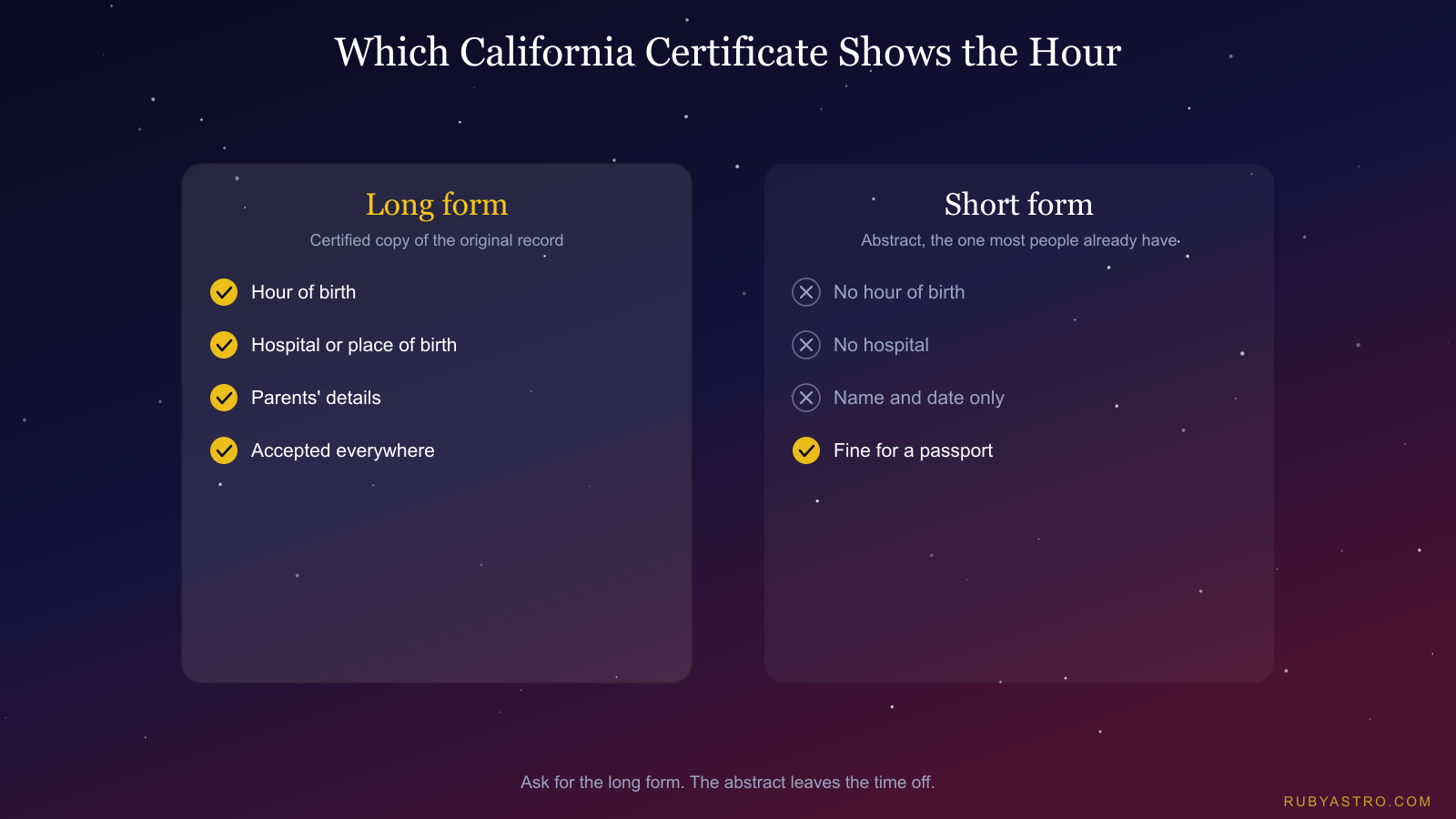 Finding Your Birth Time