If you were born while the Sun was above the horizon you have a day chart; below it, a night chart. The distinction is called sect, it is one of the oldest things in the tradition, and it changes...
The RubyAstro TeamPublished August 23, 2026Dates checked August 23, 20264 min read
Day Chart or Night Chart
The short answerIf you were born while the Sun was above the horizon you have a day chart; below it, a night chart. The distinction is called sect, it is one of the oldest things in the tradition, and it changes which planets are read as helpful and which as difficult.
How to tell which you have
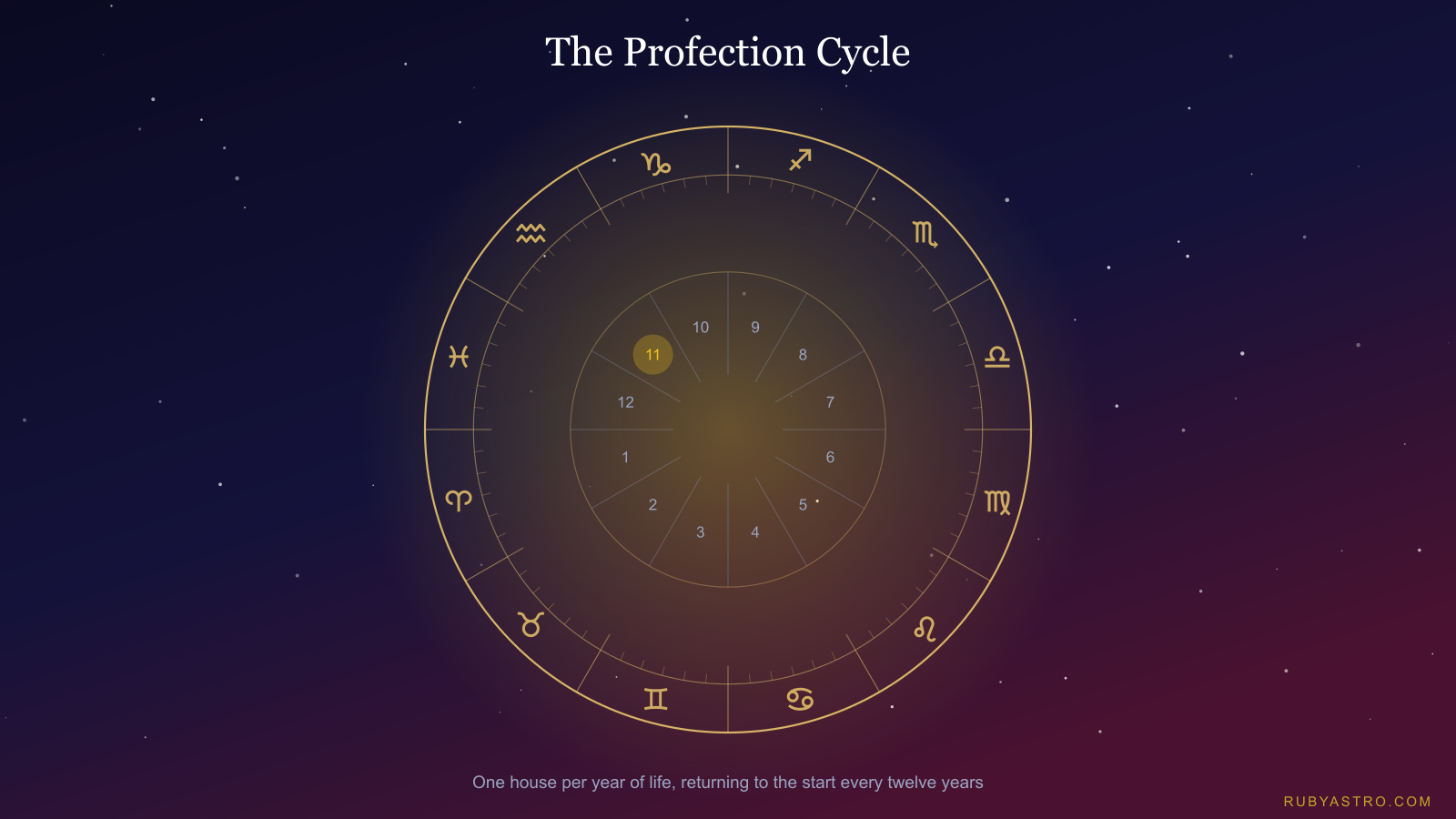
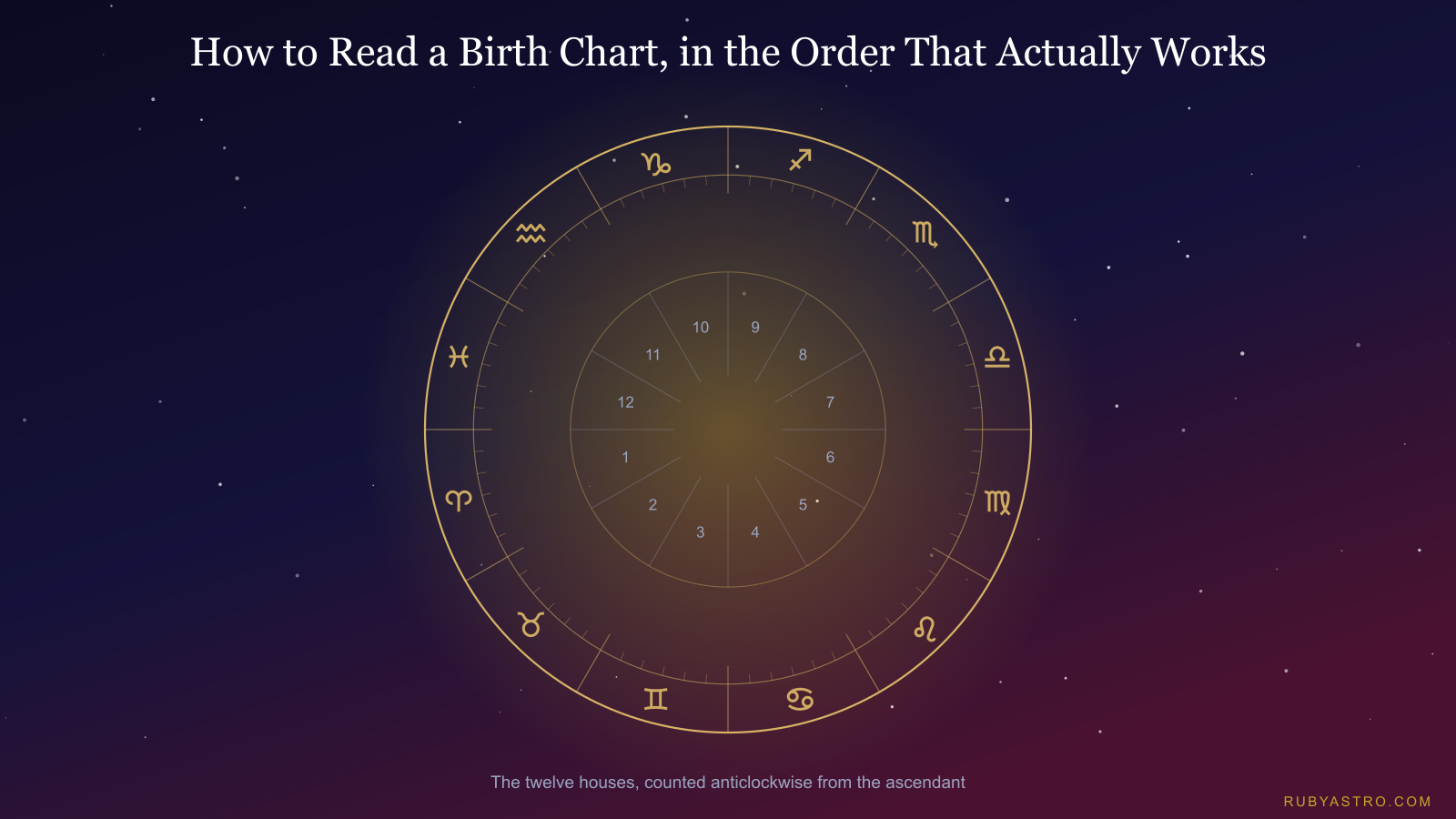
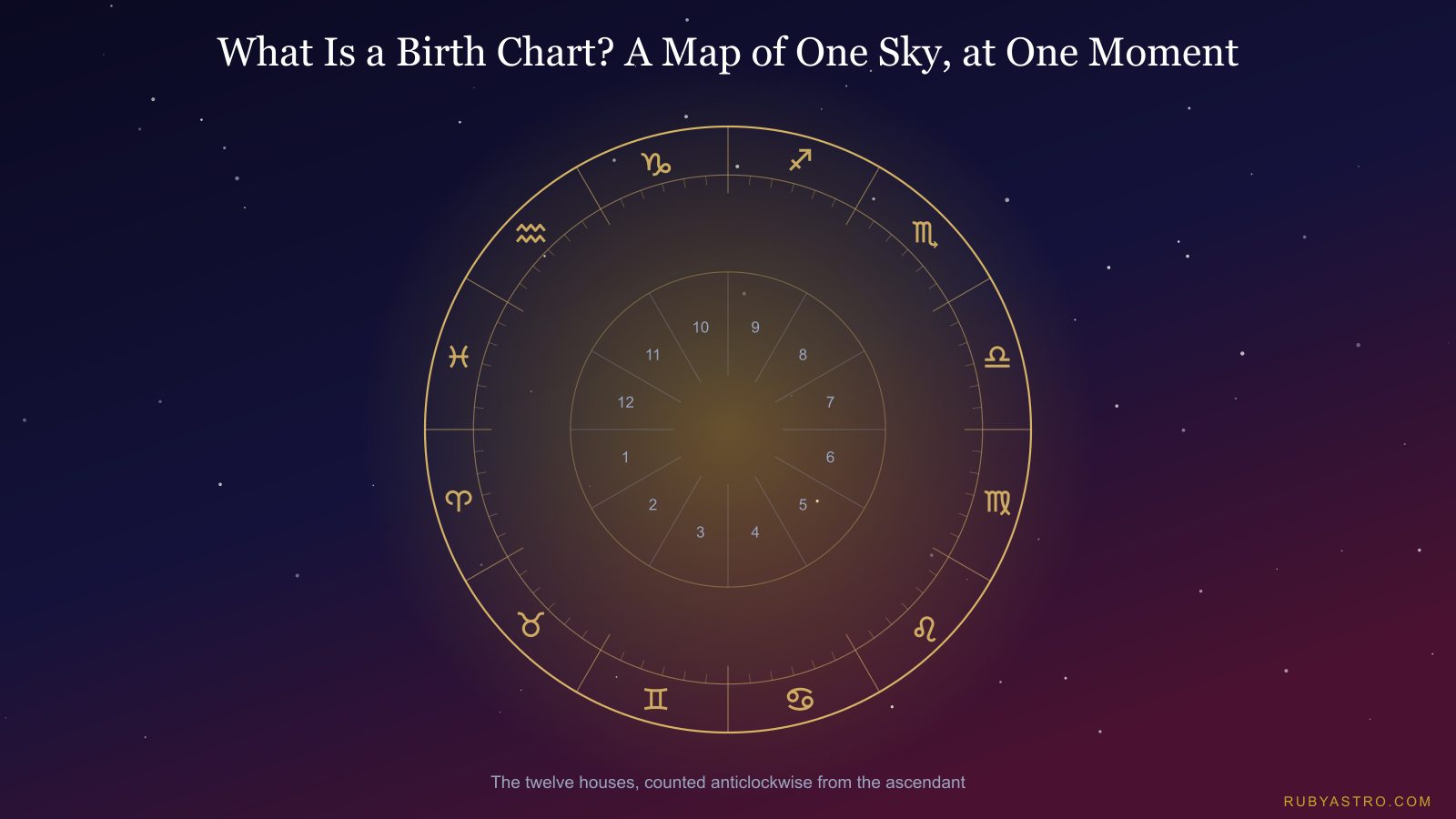
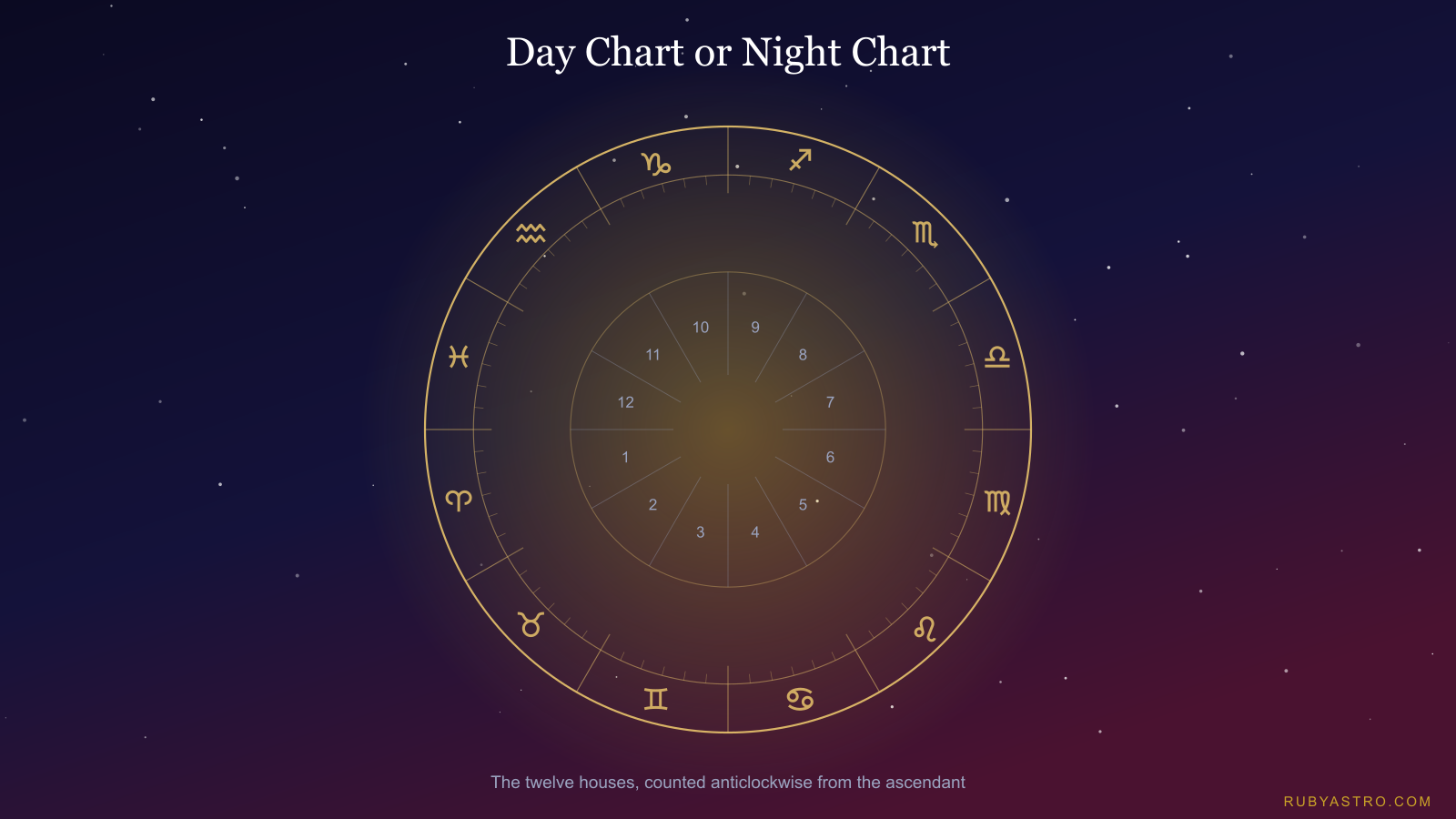
Look at where the Sun sits in your chart. Houses 7 through 12 are above the horizon, so a Sun there means a day chart. Houses 1 through 6 are below, so a Sun there means a night chart. Roughly, if you were born between sunrise and sunset it is a day chart.
If the Sun is within a few degrees of the ascendant or descendant it is a borderline case, and practitioners differ on how to call it.
What changes
Each planet is assigned to one team. The day team is the Sun, Jupiter and Saturn; the night team is the Moon, Venus and Mars. Mercury switches depending on whether it rises before or after the Sun. A planet on the same team as your chart behaves better than one on the other.
The practical consequence is the useful bit: Saturn in a day chart is noticeably less harsh than Saturn in a night chart, and Mars in a night chart is noticeably less harsh than Mars in a day chart. That single distinction accounts for a large part of why two people with the same Saturn placement report different lives.
Why it dropped out and came back
Sect is everywhere in Hellenistic astrology and almost entirely absent from twentieth-century practice. It came back in the 1990s and 2000s with the translation of the original Greek sources, and it is now one of the first things a traditionally trained astrologer checks.
If you have read that Saturn is relentless and found that yours is not, sect is the first place to look.
Sect: which planets belong to which chart
Planet
Team
In a matching chart
In a mismatched chart
Sun
Day
Operates well
Harder to express
Jupiter
Day
The most helpful thing in the chart
Helpful, but less so
Saturn
Day
Strict but constructive
The harshest placement there is
Moon
Night
Operates well
Harder to express
Venus
Night
The most helpful thing in the chart
Helpful, but less so
Mars
Night
Sharp but useful
The most difficult placement
Mercury
Either
Depends whether it rises before the Sun
The same Saturn, twice
Saturn in the 7th house in Capricorn, in a day chart: strict, demanding, and constructive. Partnerships are serious and slow and tend to last. The same placement in a night chart is the one the textbooks describe when they talk about Saturn as a malefic: the same seriousness, with much less of the constructive half.
Two people with identical Saturn placements and different sect will give you completely different accounts of what Saturn is like. That is the single most useful thing the distinction buys.
What people get wrong about this
Guessing from the time of day without checking the Sun's house. Near the equinoxes and at high latitudes, sunrise is not where you expect.
Applying sect without dignity. The two were used together and each is half the judgement.
Reading a mismatched Jupiter as bad. It is still the most helpful thing in the chart, just less so.
Forgetting Mercury switches teams depending on whether it rises before or after the Sun.
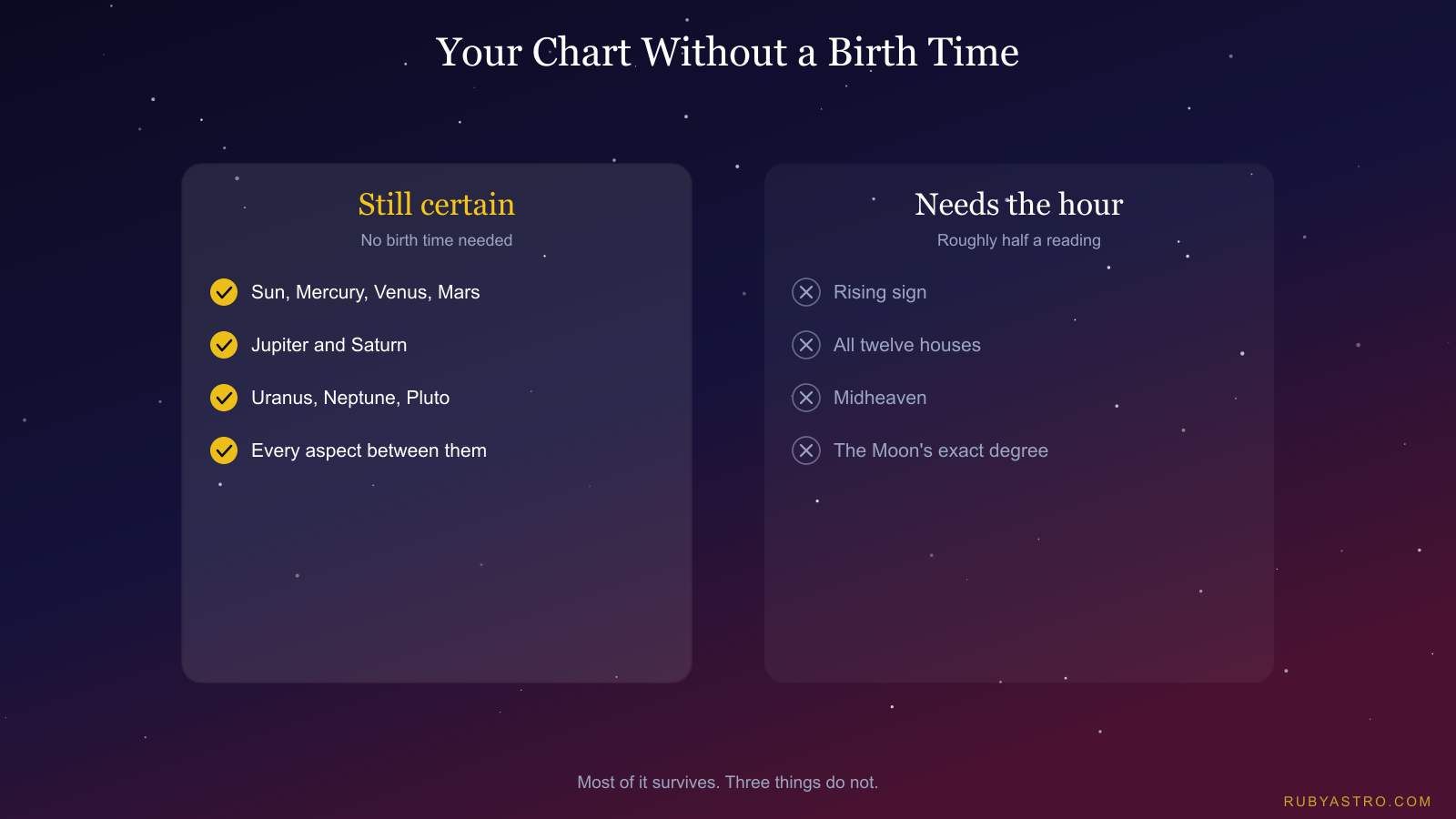
This needs your birth timeThe rising sign changes completely every two hours and moves a full degree every four minutes, so everything built on it, which is every house in the chart, needs an accurate time. Here is how to find yours, including which record to ask your state for and which one leaves the hour off.
Everything on this page is general by necessity. A reading built from your own date, time and place is the version that names your placements rather than describing the categories they fall into. If you do not know your birth time, this covers how to find it.
Questions people ask
Do I have a day chart or a night chart?
Day if the Sun was above the horizon at your birth, which means it sits in houses 7 to 12. Night if below, in houses 1 to 6.
Why does sect matter?
It decides which planets are read as helpful. Saturn is much easier in a day chart and Mars much easier in a night chart.
Is sect modern or traditional?
Thoroughly traditional. It is everywhere in Hellenistic astrology and was largely forgotten for most of the twentieth century.
RubyAstro writes about astrology for reflection and self-understanding. Nothing here is medical, legal or financial advice, and none of it is a prediction of events. Read our full disclaimer.
 Finding Your Birth Time