The Solar Return Chart: Your Year, Starting on Your Birthday
A solar return is the chart for the exact moment the Sun comes back to the degree it occupied when you were born. It happens once a year, rarely on your birthday itself, and it describes the twelve months that follow.
The RubyAstro TeamPublished October 9, 2026Dates checked October 9, 20267 min read
The Sun returns to its exact birth degree once a year, usually a day either side of your birthday rather than on it.
The short answerA solar return chart is the chart for the exact moment the Sun comes back to the position it held at your birth, which happens once a year within a day of your birthday. It is read as a forecast for the twelve months until the next one. It needs an accurate birth time, because the return moment and the chart's rising sign both depend on one.
The idea is older than it sounds and simpler than most explanations of it. The Sun takes a year to go round the zodiac and come back to where it started. The moment it arrives, you have completed a circuit, and the sky at that instant is read as a description of the circuit about to begin.
Why it is almost never on your birthday
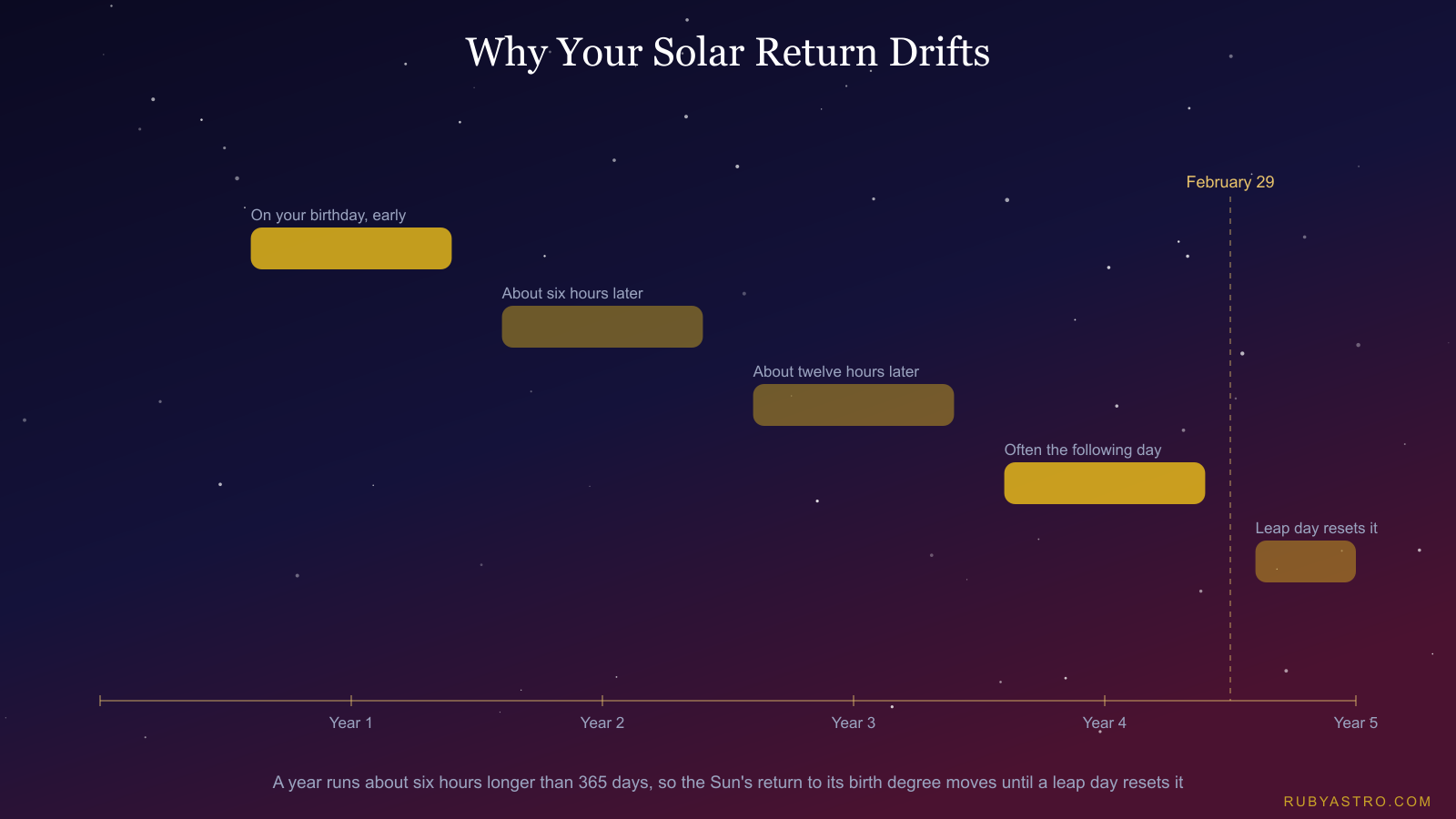
A year is not 365 days. It is about 365 days and six hours, which is why we add a day every fourth February. The Sun's return to your exact birth degree inherits that drift: it moves roughly six hours later each year, then jumps back when a leap day resets it.
So the moment can fall on your birthday, the day before, or the day after. This is the detail that most introductory pages leave out, and it is the reason people are surprised when their solar return chart is dated the 14th when they were born on the 15th.
How the solar return moment drifts across a four-year cycle
Year
Roughly when the return lands
Why
Year 1
Your birthday, early in the day
Starting point
Year 2
About six hours later
The year is six hours longer than 365 days
Year 3
About twelve hours later
The drift accumulates
Year 4
About eighteen hours later, often the following day
Still accumulating
Year 5
Back near the start, after the leap day
February 29 absorbs the four accumulated quarter days
What the chart actually shows
A solar return is read much like a natal chart, with one difference that matters: it describes a year rather than a person. The same symbol means something more temporary.
The solar return rising sign sets the tone of the year, the way the natal rising sets the tone of a life. It changes completely each year.
The house your natal Sun lands in within the return chart is the department the year is organised around.
Planets close to the return chart's angles are the ones that will be loud. A planet sitting on the return midheaven usually shows up as something public.
Aspects in the return chart describe tensions that belong to that year, not permanent features of you.
The one thing to check firstLook at which house your natal Sun falls into in the return chart. It moves every year, roughly one house per year but not reliably, and it is the single quickest read of what the coming twelve months are organised around. The rest of the chart elaborates on that.
The relocation argument
Here is a genuine disagreement among practitioners, which is worth knowing about because you will meet both positions stated as fact.
The return chart is cast for a moment and a place. Everyone agrees on the moment. The question is which place: where you were born, or where you actually are when the return happens. Because the houses depend on location, the two can produce noticeably different charts.
Some astrologers go further and recommend travelling on your birthday to produce a more favourable return chart. That practice has a long history and no agreed evidence behind it. The honest position is that this is unsettled, and a page that tells you confidently which one is correct is telling you which school it belongs to rather than what is true.
I cast both when it matters and say which is which. When the two charts tell a similar story, which they often do, the question stops being interesting. When they disagree sharply, that disagreement is usually worth discussing with the person rather than resolving behind their back.
How it differs from the other annual techniques
Several methods claim to describe the coming year, and they answer different questions.
Three ways of reading a year, and what each one is good at
Method
What it is
What it answers best
Solar return
The chart for the Sun's return to its natal degree
What the year is about, and its overall tone
Annual profection
One house activated per year of life, on a twelve-year cycle
Which area of life is in focus, and which planet runs the year
Transits
Where the planets actually are against your natal chart
When specific things are active, to the week
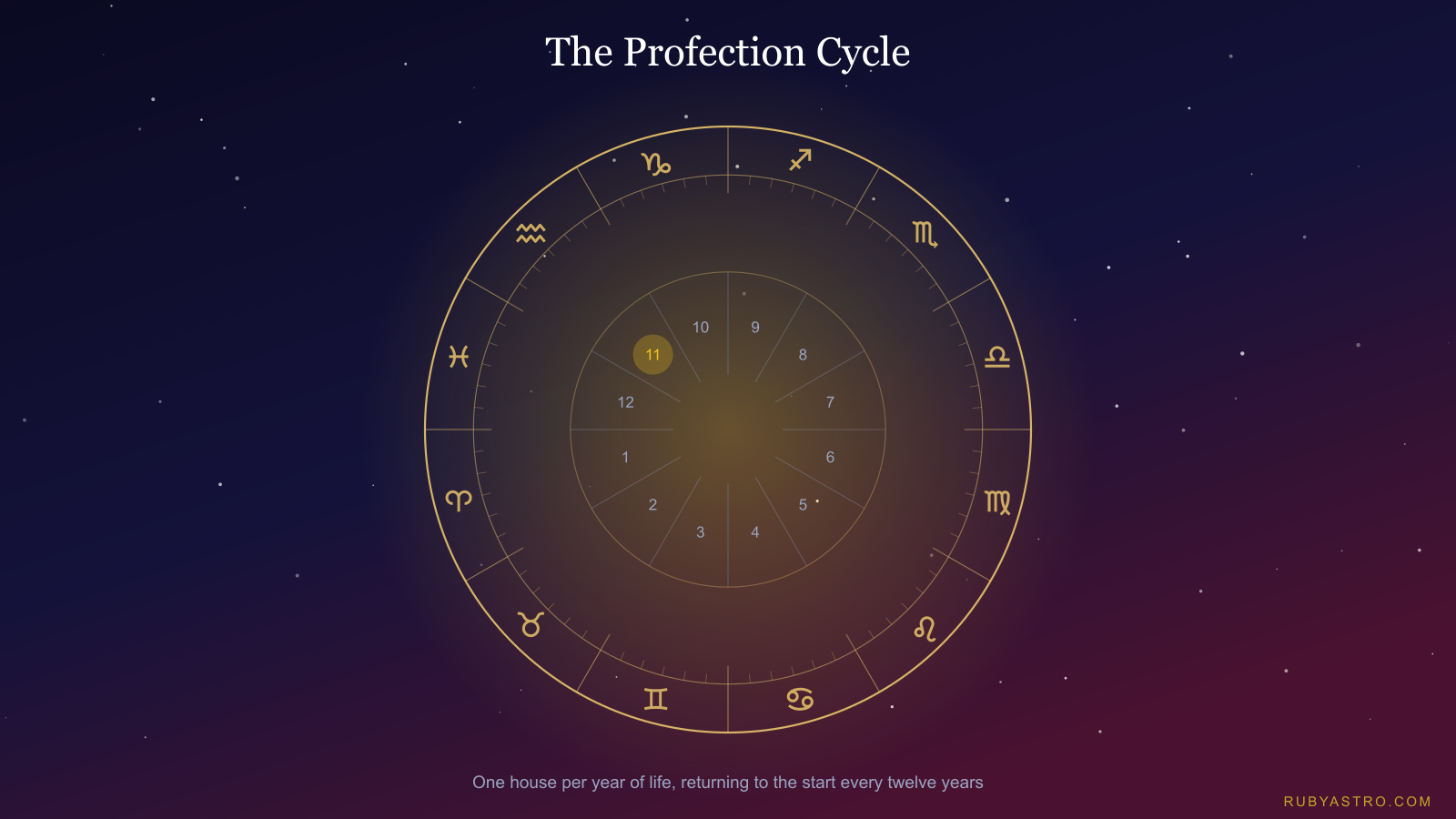
They are usually read together rather than against each other. Profections are explained here, and they are the fastest of the three to work out by hand: you only need your age.
What it will not do
A solar return does not predict events. It describes the character of a period, which is a different and more defensible claim. Read honestly, it tells you what a year is organised around and where the pressure is likely to sit. Read as a prophecy, it will either disappoint you or, worse, talk you out of something.
It is also unusually sensitive to birth-time error. Because the return chart's own rising sign moves a degree every four minutes, an hour of error in your birth data produces a return chart with a different rising sign and a completely rearranged set of houses. If your birth time is uncertain, sort that out first.
Questions people ask
What is a solar return chart?
The chart cast for the exact moment the Sun returns to the degree, minute and second it held when you were born. That moment happens once a year and the chart drawn for it describes the following twelve months.
Is my solar return always on my birthday?
Usually a day either side of it. The year is not exactly 365 days, so the return drifts. It can land the day before your birthday or the day after, and the time of day moves by about six hours each year.
Do I need my birth time for a solar return?
Yes, and precisely. The return moment is calculated from your natal Sun's exact degree, which depends on your birth time, and the solar return chart's own rising sign changes every four minutes. Without a birth time a solar return is not worth casting.
Does where I am on my birthday change the chart?
It changes the houses, because the chart is cast for a place as well as a moment. Some astrologers use the birthplace and some use where you actually are. There is no settled answer, and anyone who tells you there is has picked a side.
How long does a solar return last?
Until the next one, so twelve months. Its influence is usually described as strongest around the middle of that year rather than at the start.
RubyAstro writes about astrology for reflection and self-understanding. Nothing here is medical, legal or financial advice, and none of it is a prediction of events. Read our full disclaimer.
 Your Age in Astrology