Saturn takes 29.46 years to come back to where it was when you were born. Here are the real age windows, what the transit asks for, and why the second one at 58 is the harder of the two.
The RubyAstro TeamPublished September 28, 2026Dates checked September 28, 20268 min read
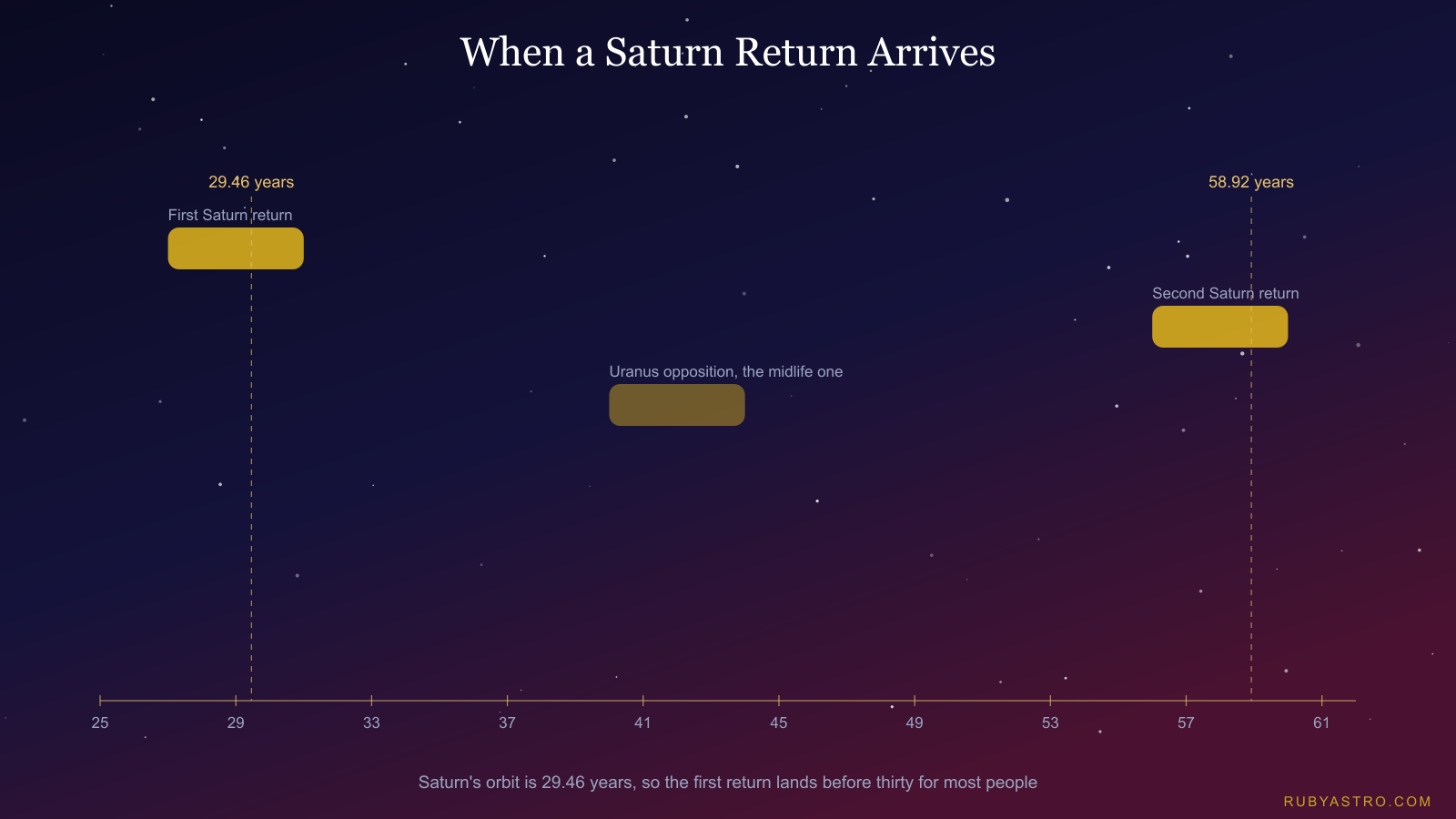
Saturn's orbit is 29.46 years, not 30, which is why the first return usually arrives before a thirtieth birthday rather than on it.
The short answerSaturn takes 29.46 years to orbit the Sun, so it returns to its birth position between ages 27 and 31 for almost everyone, and again between 56 and 60. The transit lasts from nine months to two and a half years depending on whether Saturn passes the point once or three times. It tends to force decisions that have been deferred.
The number everyone rounds off
People say the Saturn return happens at thirty. Saturn's orbital period is 29.46 years, which means for most people it arrives before their thirtieth birthday, not on it. That half year of difference is why so many people say it hit them at twenty-eight and nobody warned them.
Saturn return windows across a lifetime, from the 29.46 year orbital period
Return
Age window
Most common ages
What it usually concerns
First
27 to 31
28 to 30
Work, commitment, leaving an arrangement that was always temporary
Second
56 to 60
57 to 59
Authority, legacy, the shape of the rest of it
Third
85 to 89
86 to 88
Reckoning, inheritance, what gets handed on
Why some last three months and others last three years
This is the question people actually have, and it is the one almost nobody answers.
Saturn moves slowly, and from Earth it appears to stop and reverse for about four and a half months every year. If Saturn crosses your natal Saturn while moving forward and keeps going, you get one pass and it is over in a few months.
If Saturn crosses the point, then turns retrograde and crosses back, then turns direct and crosses a third time, you get three passes spread across roughly eighteen months to two and a half years. Those are the Saturn returns people write books about.
There is no way to know which one you get without looking at your actual chart, because it depends entirely on the degree Saturn occupied when you were born.
The myth of the Saturn return catastropheIt is not a punishment and it does not arrive to take things from you. What it reliably does is end arrangements that were only holding together because nobody had tested them. People who were already doing honest work generally describe their Saturn return as busy and tiring rather than devastating.
What it tends to ask for
Saturn deals in structure, limits and consequences. It is the part of a chart concerned with what you have actually built rather than what you intended to build.
Commitments get formalized or they get dropped. Long relationships either become marriages or end.
Work that was a placeholder stops being tolerable.
Something you have been carrying on behalf of somebody else gets handed back.
Authority becomes a live question: whose approval you are still waiting for, and whether you still need it.
The house matters more than the sign
Most writing on this focuses on which sign your Saturn is in. In practice the house is more informative, because the house is the department of life where the pressure actually lands. A Saturn return in the seventh house is about partnership. The same sign in the sixth is about work and health. You need your birth time to know which, which is why this is worth getting right first.
The second return is the harder one
Almost everything written about Saturn returns is about the first. The second one, between 56 and 60, gets a fraction of the attention and tends to be the more serious passage.
At twenty-nine the question is what you are going to build. At fifty-eight it is what you built, whether it holds, and what you intend to do with the time that remains. It often coincides with retirement decisions, with the illness or death of parents, and with the point where children become fully independent. It is quieter and it goes deeper.
The clients who find the first return hardest are the ones who were doing something they had privately decided against years earlier. The transit does not create that situation. It just makes it impossible to keep postponing. And people in their second return almost never describe it as a crisis. They describe it as finally being honest about the arithmetic.
How to find yours
Find the sign and degree of Saturn in your birth chart.
Add 29.46 years to your birth date. That is the approximate first return.
Check whether Saturn stations retrograde near that degree in that period. If it does, expect the longer version.
Look at which house your natal Saturn occupies. That is where the pressure will show up.
If you are not sure which house your Saturn is in, the birth time is the reason. Here is how to find yours.
Questions people ask
When exactly is my Saturn return?
The first one falls between ages 27 and 31, most often between 28 and 30. The precise timing depends on where Saturn sat in your birth chart and whether it was moving direct or retrograde at the time.
How long does a Saturn return last?
Between about nine months and two and a half years. If Saturn passes the point once it is quick. If it retrogrades back over it, you get three passes and a much longer stretch.
Is a Saturn return always bad?
No. It is demanding rather than bad. The common thread is that arrangements built on something unstable tend to come apart, and arrangements built properly tend to get formalized.
RubyAstro writes about astrology for reflection and self-understanding. Nothing here is medical, legal or financial advice, and none of it is a prediction of events. Read our full disclaimer.
 Finding Your Birth Time