Selenite is gypsum, Mohs 2, used for clearing, calm, cleansing other stones. The mineralogy, whether it is safe in water and sunlight, what gets substituted for it, and what a stone can honestly do.
The RubyAstro TeamPublished July 6, 2026Dates checked July 6, 20265 min read
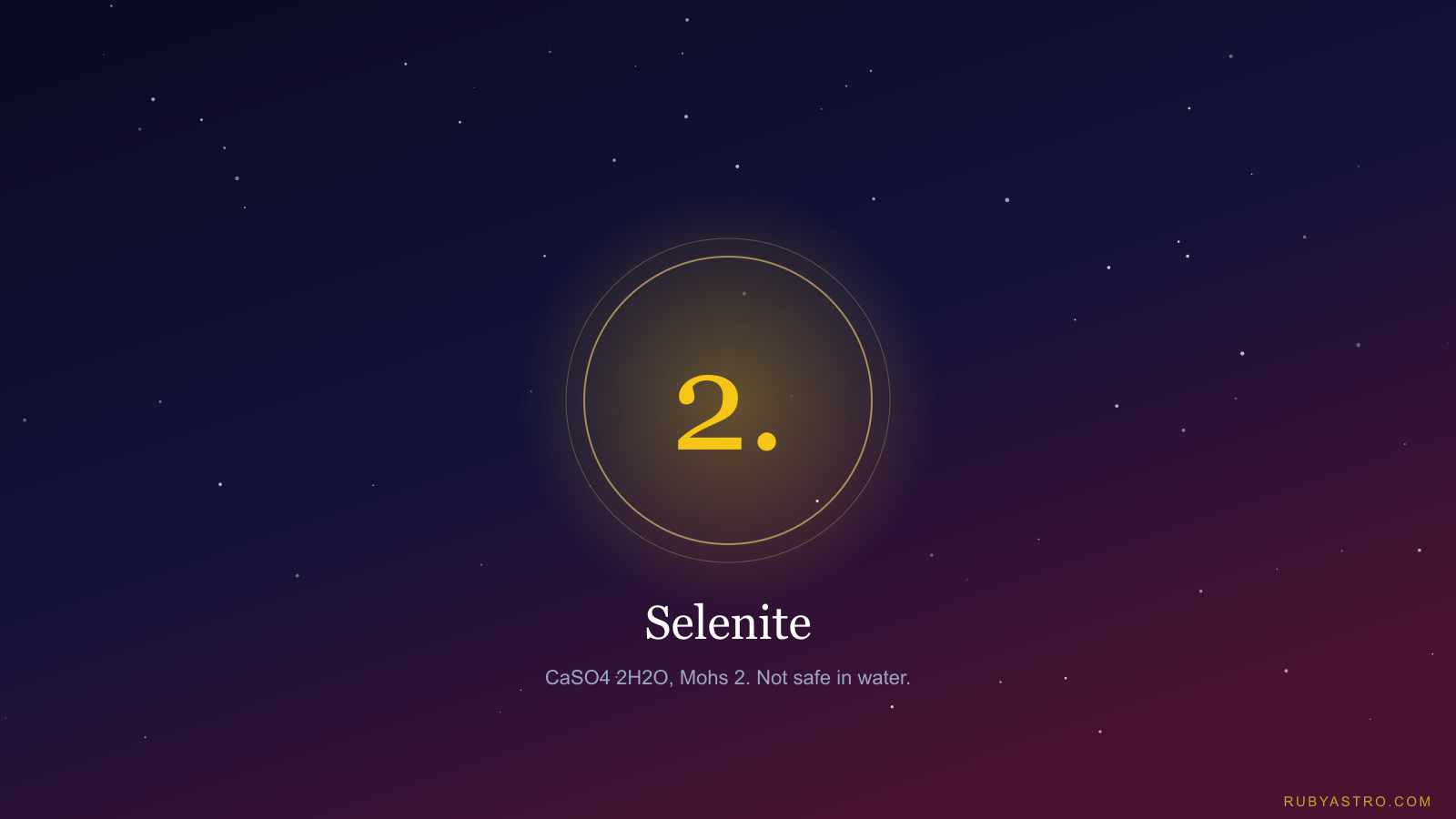
Selenite: CaSO4 2H2O, Mohs 2. Not safe in water.
The short answerSelenite is gypsum, CaSO4 2H2O, Mohs hardness 2. It is used for clearing, calm, cleansing other stones, and associated with the Crown chakra. On care, the short version: keep it out of water entirely, and sunlight does no harm.
What selenite actually is
Start with the mineralogy, because most of the bad advice about this stone follows from not knowing it. Selenite is gypsum. On colour: None. The white is internal fibres scattering light, not pigment.
Where it comes from: Morocco is the source of almost all the sticks and lamps on sale. The largest crystals ever found are in a cave in Chihuahua, Mexico, some of them eleven metres long.
Selenite at a glance
Property
Value
Mineral species
Gypsum
Chemical formula
CaSO4 2H2O
Mohs hardness
2
Crystal system
Monoclinic
Chakra
Crown
Usually linked to
Cancer, and to the Moon
Hardness matters more than it sounds. The Mohs scale runs from talc at 1 to diamond at 10, and anything below about 5.5 can be scratched by ordinary window glass or by the quartz dust in everyday grit. At 2, selenite is soft enough to damage in a pocket with keys or in a bowl with other stones. Keep it separate.
What selenite is used for
Used more as a tool than as a stone in its own right: the usual practice is to rest other crystals on a selenite slab to clear them. It is also the one people keep by the bed, and at Mohs 2 it is soft enough to mark with a fingernail.
In the shorthand most shops and books use, it is a Crown stone, and the three words attached to it most often are clearing, calm, cleansing other stones.
Water, sunlight and salt
This is the section that matters, and the one most pages get wrong. Cleansing advice is handed around as though every stone were the same mineral, and it is not. Here is what selenite will actually survive.
Caring for selenite
Method
Safe?
Why
Water
No
Never in water.
Direct sunlight
Yes
Direct sunlight does no damage.
Salt or salt water
No
No salt, dry or dissolved. It is abrasive and it attacks softer and porous stones.
Moonlight
Yes
Harmless to every stone on this list, which is most of why it is the method that suits everything.
Smoke, sound or breath
Yes
Nothing physical touches the stone, so nothing can be damaged by it.
Before you put selenite anywhereSelenite is a hydrated calcium sulfate and it dissolves in water. Not slowly, and not only in a long soak: running a selenite stick under a tap will visibly fur the surface and a wet cloth will dull it permanently. Any page that tells you to cleanse selenite in water or in salt water is telling you to destroy it. Dust it dry.
Buying selenite without being had
Sold under several names for the same mineral: satin spar is the fibrous white material almost all lamps and sticks are cut from, while true selenite is the transparent variety. Shops use the words interchangeably. It is the same species either way, and the price difference is mostly marketing.
Two general rules that hold across the whole shop. If the price is far below everything else on the shelf of that size, something has been substituted or treated. And a stone sold with no locality at all is usually one the seller cannot trace, which in this trade often means tumbled, dyed and bagged somewhere a long way from where it came out of the ground.
The astrology people attach to it
Selenite is usually linked to Cancer, and to the Moon. Worth being straight about this: crystal and zodiac pairings are modern, they are not consistent between sources, and two reputable books will give you two different signs for the same stone. They are a useful organising idea rather than a tradition with a single lineage behind it.
If you want the part of this that does have a fixed method behind it, the Sun in Cancer sets out what that sign actually describes, and it is calculated from a date rather than assigned by a writer.
How people actually use selenite
Pick one thing for it to mean. A stone with four jobs has none. Clearing is enough.
Put it where the thing happens, not where it looks good. A stone for sleep belongs by the bed; a stone for nerve belongs in the pocket you will actually reach into.
Handle it. The whole mechanism such as it is runs on the object interrupting you and reminding you of the thing you decided. A stone in a drawer does nothing.
Clean it by whatever method the table above allows, when it feels due rather than on a schedule somebody else set.
A word on crystal elixirsPutting stones in drinking water is a popular practice and a genuinely risky one. Several common minerals are toxic, soluble or both: malachite is a copper carbonate, cinnabar contains mercury, galena is lead, and selenite simply dissolves. If you want to make an elixir at all, use the indirect method, with the stone in a sealed glass container standing inside the water rather than in it.
What a stone can and cannot doNo crystal treats an illness, and no controlled study has found that one does. What the practice reliably provides is a physical object attached to an intention, which is a genuinely useful thing: it is a reminder you can hold, and keeping something in your pocket that means one specific thing works the way any ritual works. Nothing on this page should be used in place of medical advice, and nobody should delay treatment for it.
If you want something built from your own details
Every piece of selenite in the shop is the same stone with the same associations, which is both the appeal and the limit of it. A birth chart is the opposite: it is calculated from your date, time and place and it describes one person. If you do not know your birth time, this covers how to find it.
Questions people ask
Can selenite go in water?
No. Selenite is a hydrated calcium sulfate and it dissolves in water.
Does selenite fade in sunlight?
No. Sunlight does not damage it.
What is selenite used for?
Clearing, calm, cleansing other stones. It is associated with the Crown chakra.
How hard is selenite?
Mohs 2. That is soft, so keep it away from keys, grit and harder stones.
What gets sold as selenite?
Sold under several names for the same mineral: satin spar is the fibrous white material almost all lamps and sticks are cut from, while true selenite is the transparent variety.
RubyAstro writes about astrology for reflection and self-understanding. Nothing here is medical, legal or financial advice, and none of it is a prediction of events. Read our full disclaimer.
 Finding Your Birth Time