A Full Moon birth means the Moon was 180 to 225 degrees ahead of the Sun. The arithmetic to check your own, what the phase is read as, and why it is not your Moon sign.
The RubyAstro TeamPublished October 2, 2026Dates checked October 2, 20265 min read
Full Moon: the Moon 180 to 225 degrees ahead of the Sun.
The short answerBorn under a Full Moon means the Moon was between 180 and 225 degrees ahead of the Sun at the moment you were born. The phase is about seeing it clearly, usually through other people. To check your own: take your Moon's longitude, subtract your Sun's, add 360 if the answer is negative, and look the result up in the table below.
How to work out your own birth phase
This is arithmetic rather than interpretation, and you can do it with any chart that gives degrees. The lunar month is the Moon pulling ahead of the Sun by 360 degrees over 29.53 days. Where it had got to when you were born is your phase.
Find your Moon's position in zodiac degrees. Each sign is 30 degrees, counting from 0 at the start of Aries, so 12 degrees of Gemini is 60 plus 12, which is 72.
Do the same for your Sun.
Subtract the Sun from the Moon. If the answer is below zero, add 360.
Look the number up in the table. That is your phase.
The eight phases, by the angle between Sun and Moon
Degrees ahead
Phase
What it is about
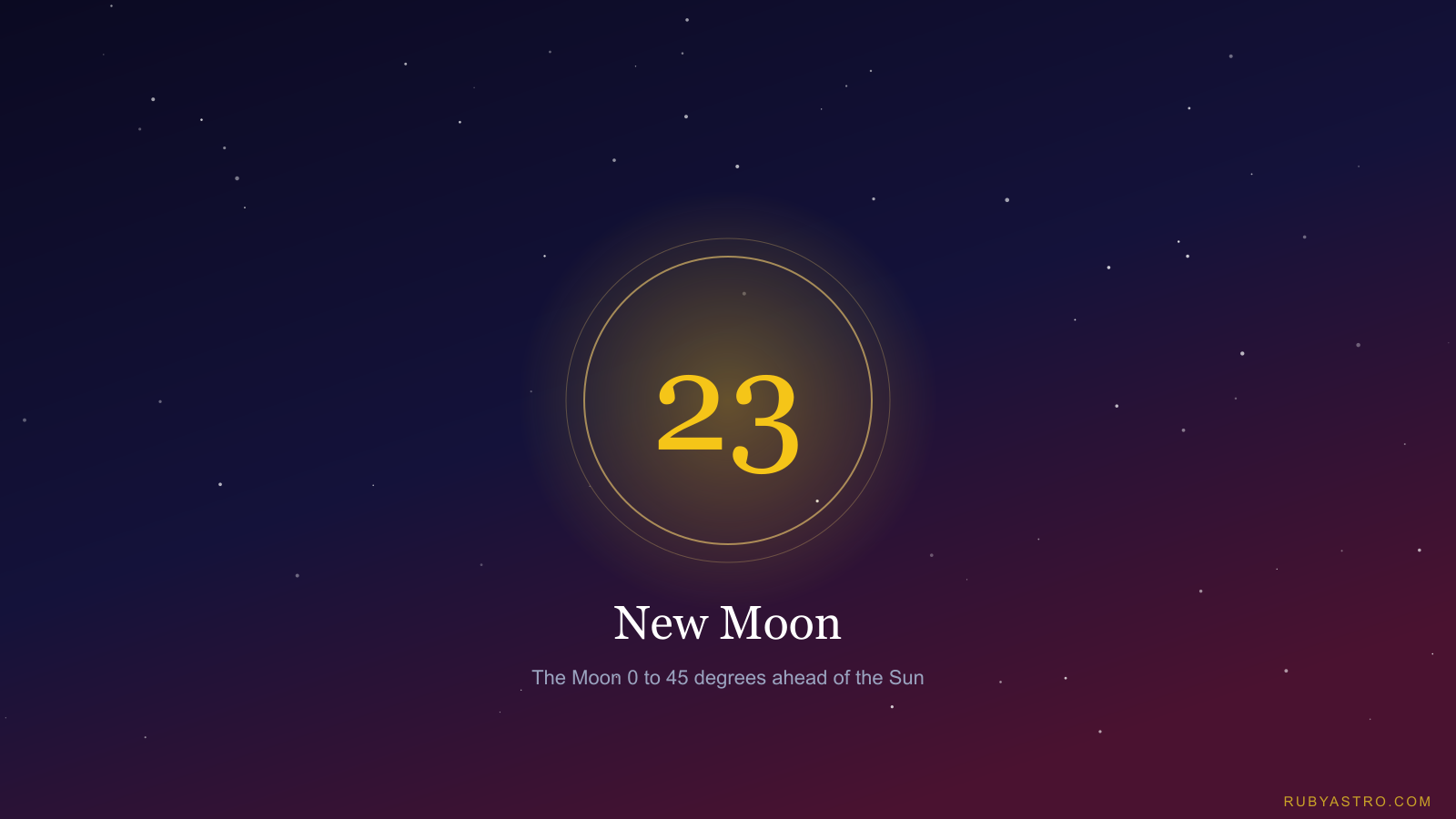
0 to 45
New Moon
starting, instinctively and without much reference to precedent
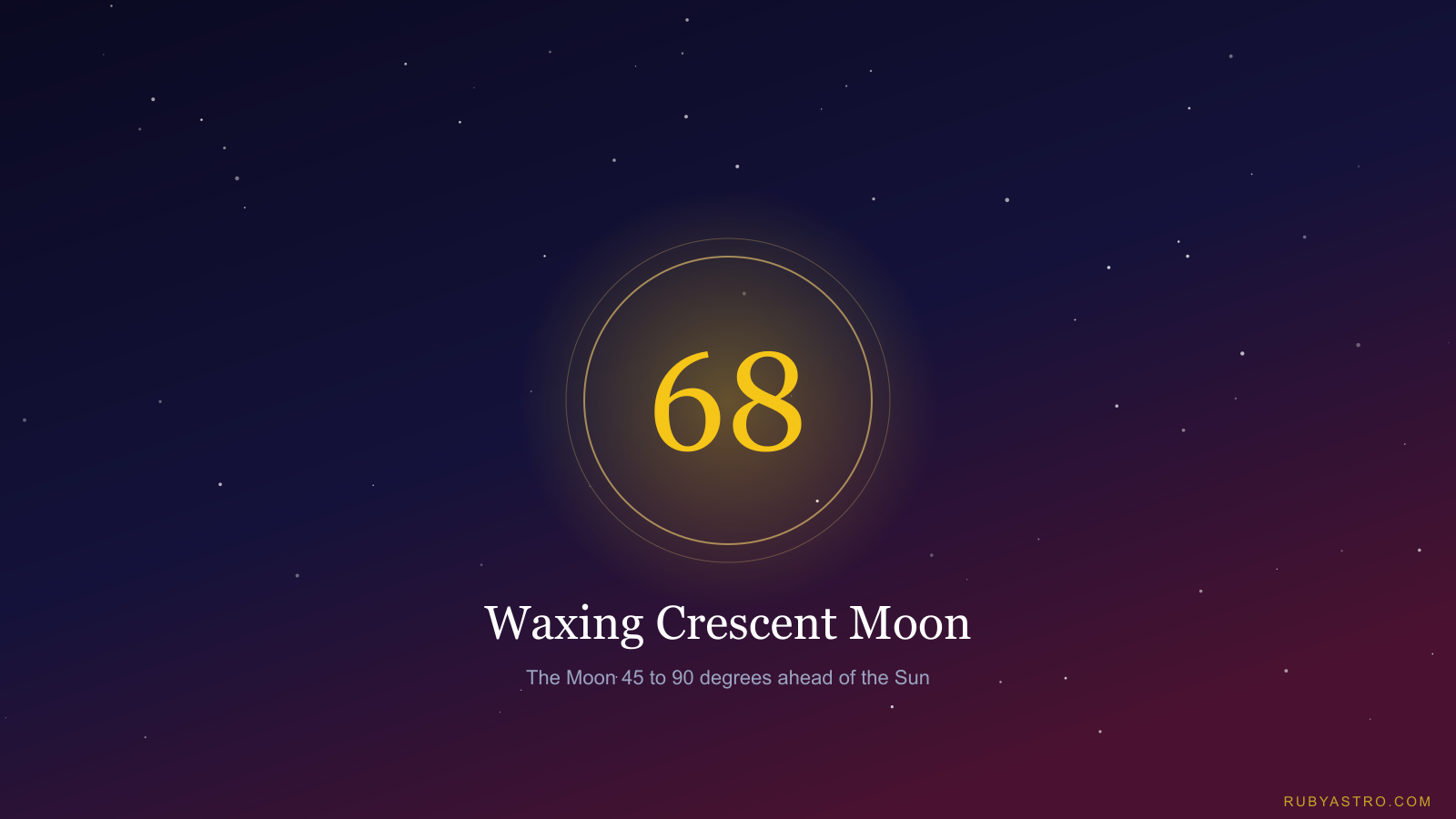
45 to 90
Waxing Crescent Moon
pushing off from where you came from
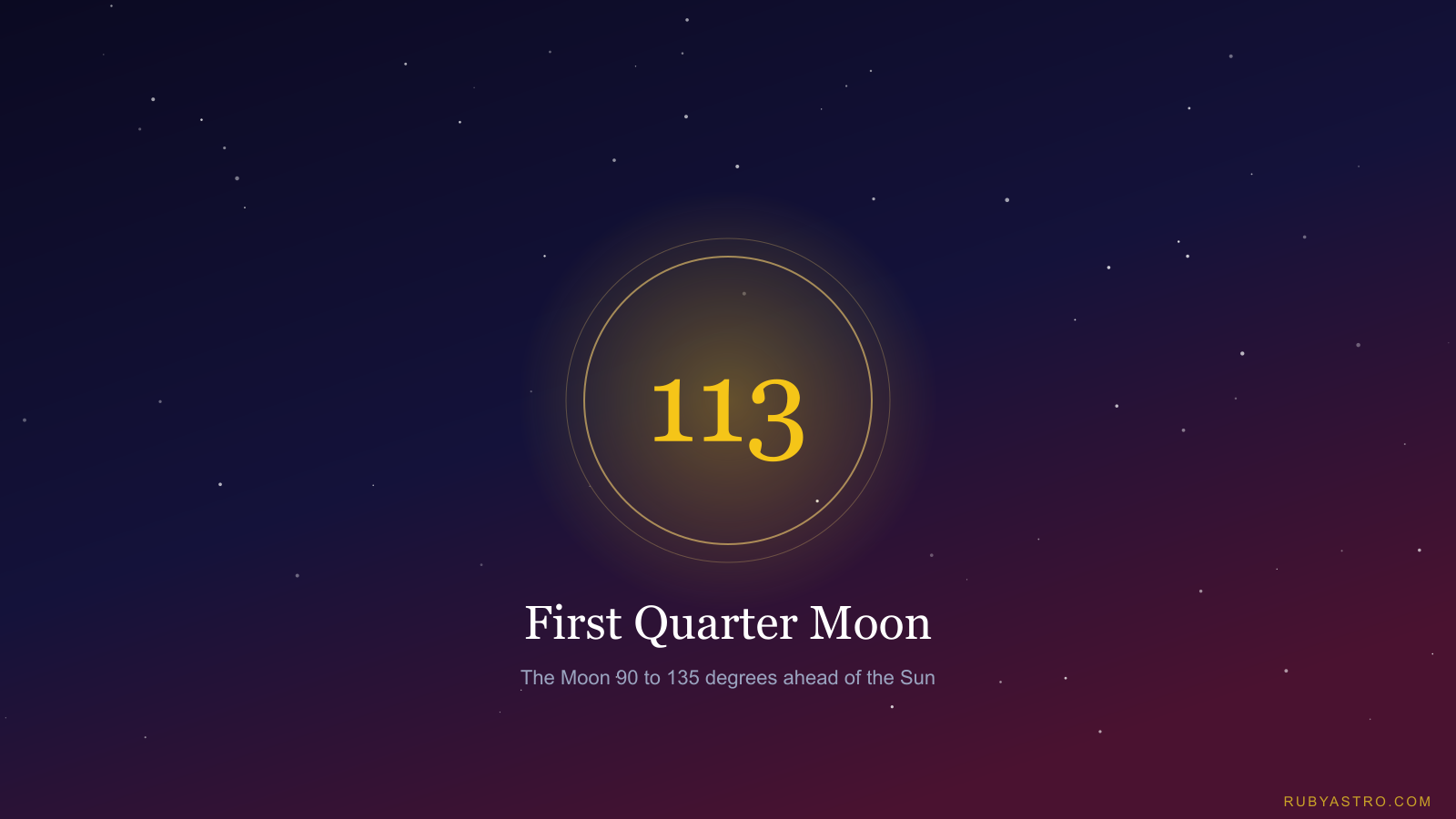
90 to 135
First Quarter Moon
building, against resistance
135 to 180
Waxing Gibbous Moon
refining, adjusting, asking what it is for
180 to 225
Full Moon (this one)
seeing it clearly, usually through other people
225 to 270
Waning Gibbous Moon
passing it on
270 to 315
Last Quarter Moon
taking it apart
315 to 360
Balsamic Moon
finishing, and quietly
Each phase covers 45 degrees, which the Moon crosses in about three and three quarter days. So roughly one person in eight shares your birth phase, and the whole cycle repeats every 29.53 days. That is a far wider net than a birth chart and a much narrower one than a Sun sign.
What a Full Moon birth is read as
Born at an opposition, and relationships are where the chart gets worked out. Awareness tends to arrive through another person reflecting something back.
It sits between the Waxing Gibbous Moon, which is about refining, adjusting, asking what it is for, and the Waning Gibbous Moon, which is about passing it on. If you were born within a few hours of a boundary, read both. The phases are a continuum that somebody drew eight lines across, not eight boxes.
The same cycle, running slowly, across your life
There is a second version of this that almost nobody mentions on a page about birth phases, and it is the more useful one. In secondary progressions, where one day after birth stands for one year of life, the Moon pulls ahead of the Sun at about twelve degrees a year instead of twelve degrees a day. So the whole lunation cycle plays out once over roughly twenty-nine and a half years of living.
That gives a progressed new moon at about 29 and again at about 59, a progressed full moon at about 15 and 44, and the eight phases spread across the gaps at roughly three and a half years each. People who track it describe the progressed new moon as the clean start and the progressed full moon as the point where whatever started then becomes visible, for better or worse.
The division into eight is modern. It was set out by Dane Rudhyar in the 1960s, drawing on an older idea of the lunation cycle, and it is the version in general use today. The phases themselves are as old as looking up. The personality reading attached to them is about sixty years old, which is worth knowing before deciding how much weight to give it.
What this is not
It is not your Moon sign, and the two get mixed up constantly. Your Moon sign is which sign the Moon was in. Your birth phase is how far ahead of the Sun it was. You can have the Moon in Leo at any phase at all, and the two say different things.
It is also not the same as which phase is in the sky tonight. That is a shared calendar. Your birth phase is fixed for life and does not change.
What the Moon does and does not doThe Moon moves the tides because it pulls on an entire ocean. It does not measurably pull on a person: the tidal force across a human body is smaller than the force of the person sitting next to you. The large studies looking for lunar effects on births, psychiatric admissions and crime have not found them. None of that makes a lunar practice pointless. It makes it a calendar: a recurring, visible, shared prompt to stop and check what you are doing, which is a real use and an honest description of one.
If you want it calculated rather than worked out by hand
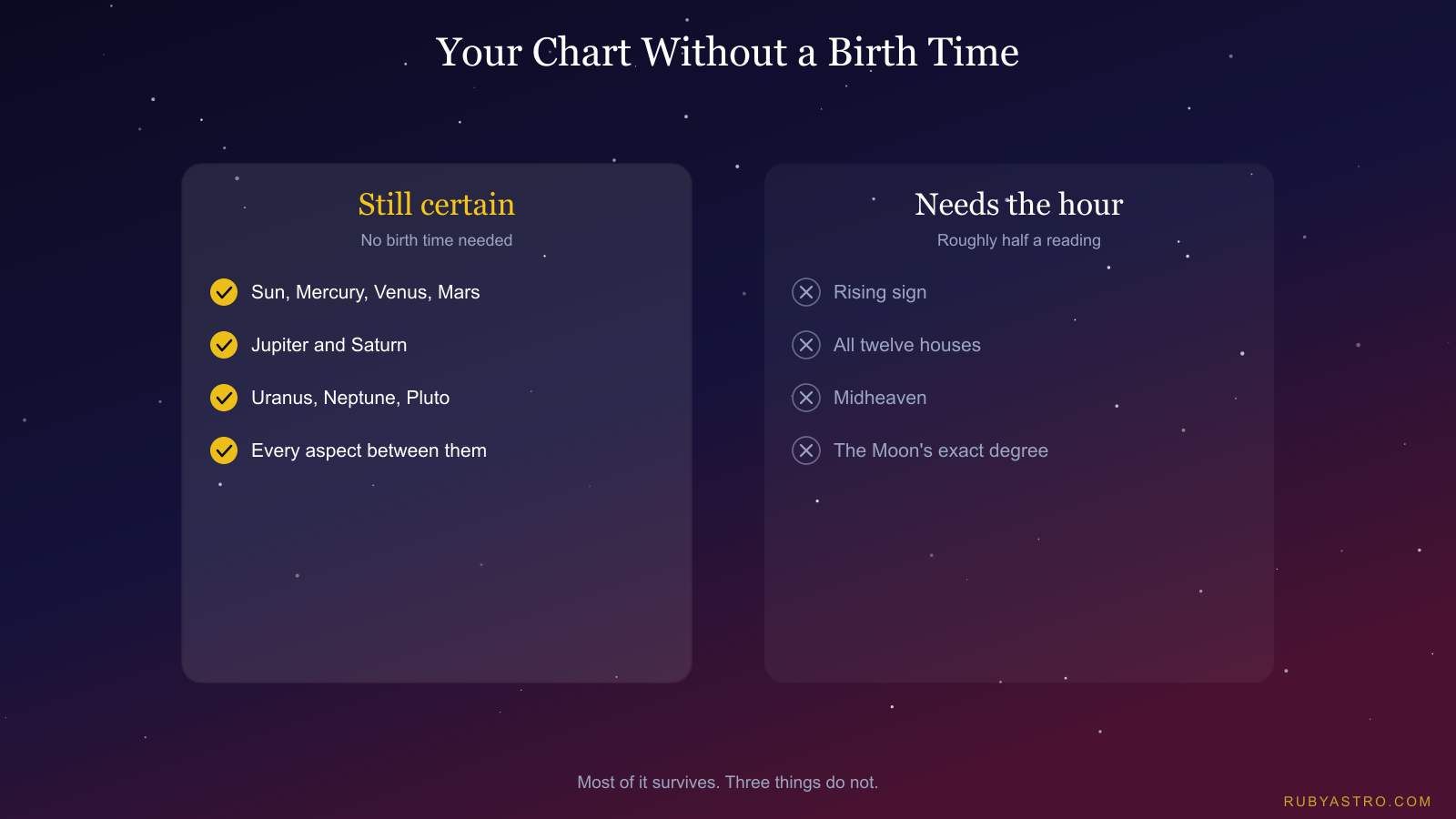
The arithmetic above needs your Moon's degree, and the Moon moves about half a degree an hour, so a chart built without a birth time can put it in the wrong sign entirely. Here is how to find your birth time.
Questions people ask
What moon phase was I born under?
Subtract your Sun's zodiac longitude from your Moon's, add 360 if the result is negative, and look it up. 180 to 225 degrees is a Full Moon.
What does a Full Moon birth mean?
Seeing it clearly, usually through other people. Born at an opposition, and relationships are where the chart gets worked out.
Is my birth phase the same as my Moon sign?
No. The Moon sign is which sign the Moon was in. The phase is how far ahead of the Sun it was. They are independent.
How common is a Full Moon birth?
About one person in eight. Each phase covers 45 of the 360 degrees of the cycle.
RubyAstro writes about astrology for reflection and self-understanding. Nothing here is medical, legal or financial advice, and none of it is a prediction of events. Read our full disclaimer.
 Finding Your Birth Time