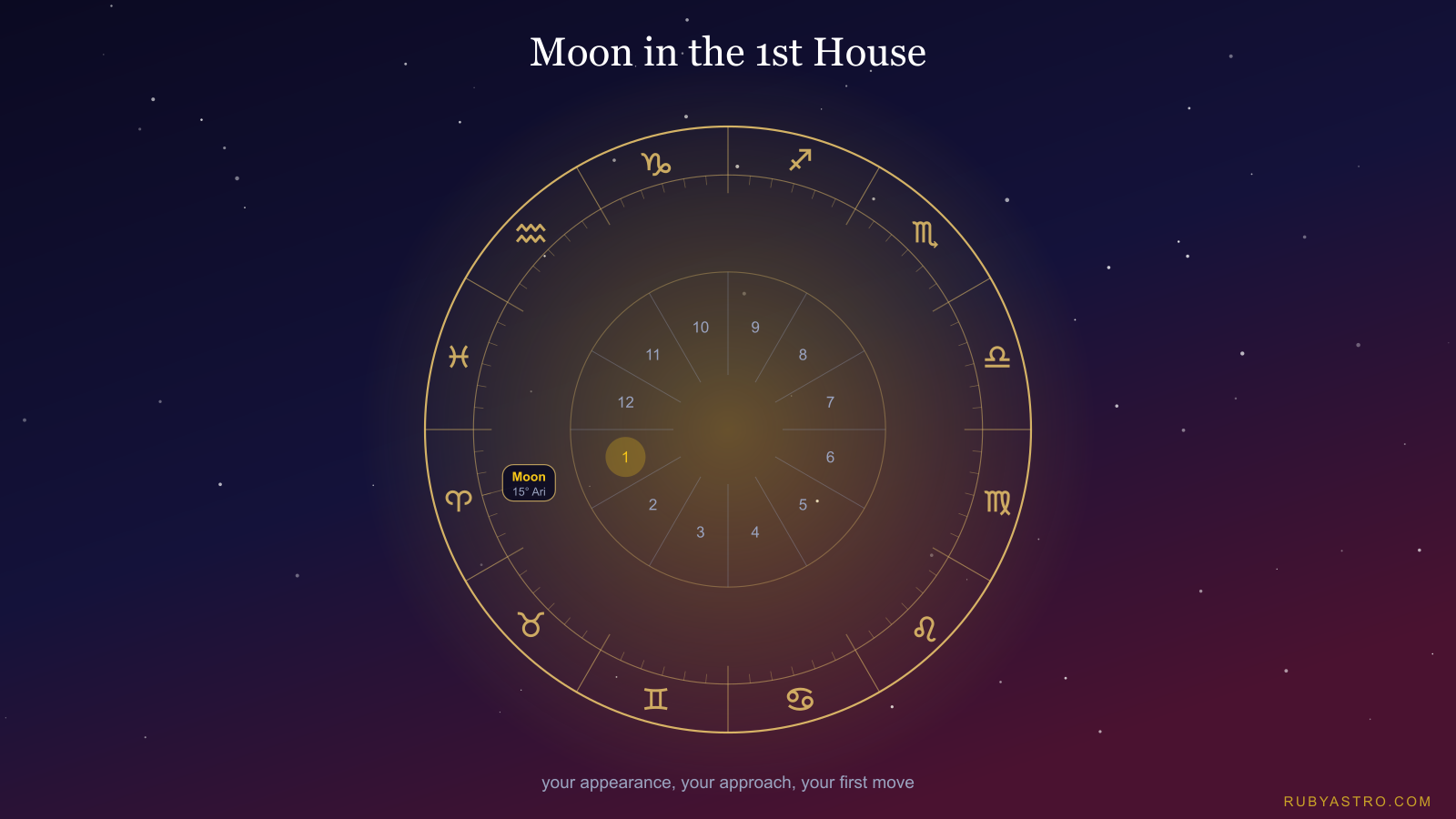
 Planets in Houses
Moon in the First House: What It Means
Moon in the first house puts feelings, needs and home into the department of self and first impressions. Here is what it does, where it strains, and which sign that means for your rising sign.
Tarot
The High Priestess means knowing, secrecy, waiting. What it means upright and reversed, the four ways readers handle reversals, and the Moon attribution the Golden Dawn gave it.
Pamela Colman Smith drew The High Priestess as a seated figure between a black pillar and a white one, a veil of pomegranates behind her, a crescent at her feet and a half-hidden scroll in her lap. Start there rather than with a keyword list. The scene is the reading, and it is the reason this deck took over from every deck that showed the Majors as plain allegorical figures.
Something is known and not yet said, and there is usually a good case for not saying it yet. This is the card of information that is not ready to be handled.
The question it actually puts to you: what you already know and are talking yourself out of. That is the useful part. A card that only tells you what is happening is a horoscope; a card that asks you something is doing the job.
| If the question is about | The High Priestess upright | Reversed |
|---|---|---|
| Love | Unspoken feeling. Something being held back on one side. | Read it as the same thing blocked, inverted or taken too far |
| Work | Information you have not been given, and are being affected by anyway. | Usually the delayed version rather than the opposite |
| Money | Do not decide on partial figures. | Check the cards either side before deciding which |
Secrets that have gone stale and started to cost something, or an instinct overruled by an argument.
That is one reading of it, and readers do not agree on how reversals work. There are four common methods, they give different answers, and nobody who tells you theirs is the correct one is describing the tradition honestly.
| Method | What the reversal means | When it fits best |
|---|---|---|
| Blocked or delayed | The upright meaning, not available yet | The most common method. Works on almost any card |
| The opposite | The reverse of the upright meaning | Cards with a clear opposite, like the Sun or the Ten of Cups |
| Turned inward | The upright meaning, happening privately | The feeling cards, and most of the Cups |
| Too much of it | The upright quality in excess | The strong cards: Strength, the Emperor, the King of Wands |
Plenty of readers shuffle so that reversals never occur, and read the surrounding cards for the same information instead. That is a legitimate method, not a shortcut.
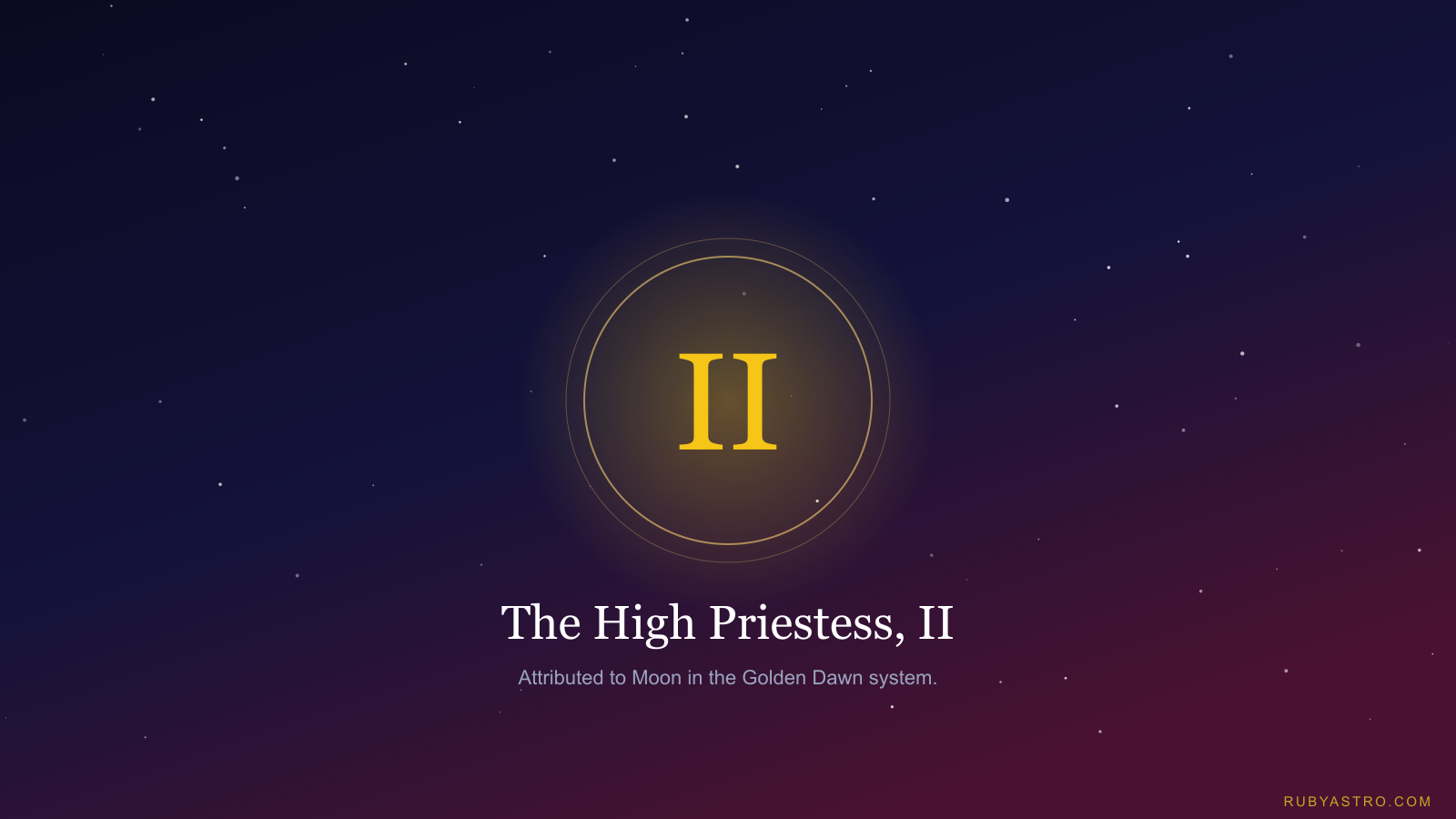
Every Major Arcana card has a planetary, zodiacal or elemental attribution in the Golden Dawn system, and The High Priestess takes Moon. The card carries the planet's job rather than a sign's temperament, which is why it shows up as a function in a reading: knowing, secrecy, waiting.
| Field | Value |
|---|---|
| Number | II (2) |
| Arcana | Major |
| Attributed to | Moon |
| Kind of attribution | Planet |
| Keywords | Knowing, Secrecy, Waiting |
The Hermit. Both withdraw from the room. She is withholding something; he is looking for something.
Worth knowing, because most pages present card meanings as though they were handed down from antiquity. Playing cards reached Europe in the fourteenth century and the earliest surviving tarot decks were painted in northern Italy in the fifteenth, as a card game. For roughly three hundred years that is all they were. Divination with them is first clearly documented in the late eighteenth century, in France.
The meanings in use today in English are almost entirely the Rider deck's. It was published in London in 1909: Arthur Edward Waite wrote the scheme, Pamela Colman Smith drew all seventy-eight cards, and she was paid a flat fee and went uncredited on the box for most of a century. Her decision to give every pip card a scene rather than a plain arrangement of symbols is the single reason modern tarot works the way it does, because a picture can be read by somebody who has memorised nothing.
Both of them were members of the Hermetic Order of the Golden Dawn, which is where the astrological attributions on this page come from. Those are a genuine system with internal logic, and they are a little over a century old rather than ancient. Saying so costs nothing and it is the difference between a page you can trust on the rest of the detail and a page you cannot.
A card describes a situation. It does not know anything about you specifically, because the deck is the same deck for everybody who picks it up. A birth chart is the opposite: it is built from your date, time and place of birth and it describes one person. Here is how to find your birth time if you do not have it.
The High Priestess means knowing, secrecy, waiting.
Readers use four different methods for reversals: blocked, opposite, turned inward, or too much of it. The article sets out all four, because they give different answers and no single one is the correct reading.
Moon, in the Golden Dawn system the Rider deck was built on.
No. A card describes a situation and asks a question about it. Nothing in the tradition names a date, and nothing in it should stand in for medical, legal or financial advice.
RubyAstro writes about astrology for reflection and self-understanding. Nothing here is medical, legal or financial advice, and none of it is a prediction of events. Read our full disclaimer.
Planets in HousesMoon in the first house puts feelings, needs and home into the department of self and first impressions. Here is what it does, where it strains, and which sign that means for your rising sign.
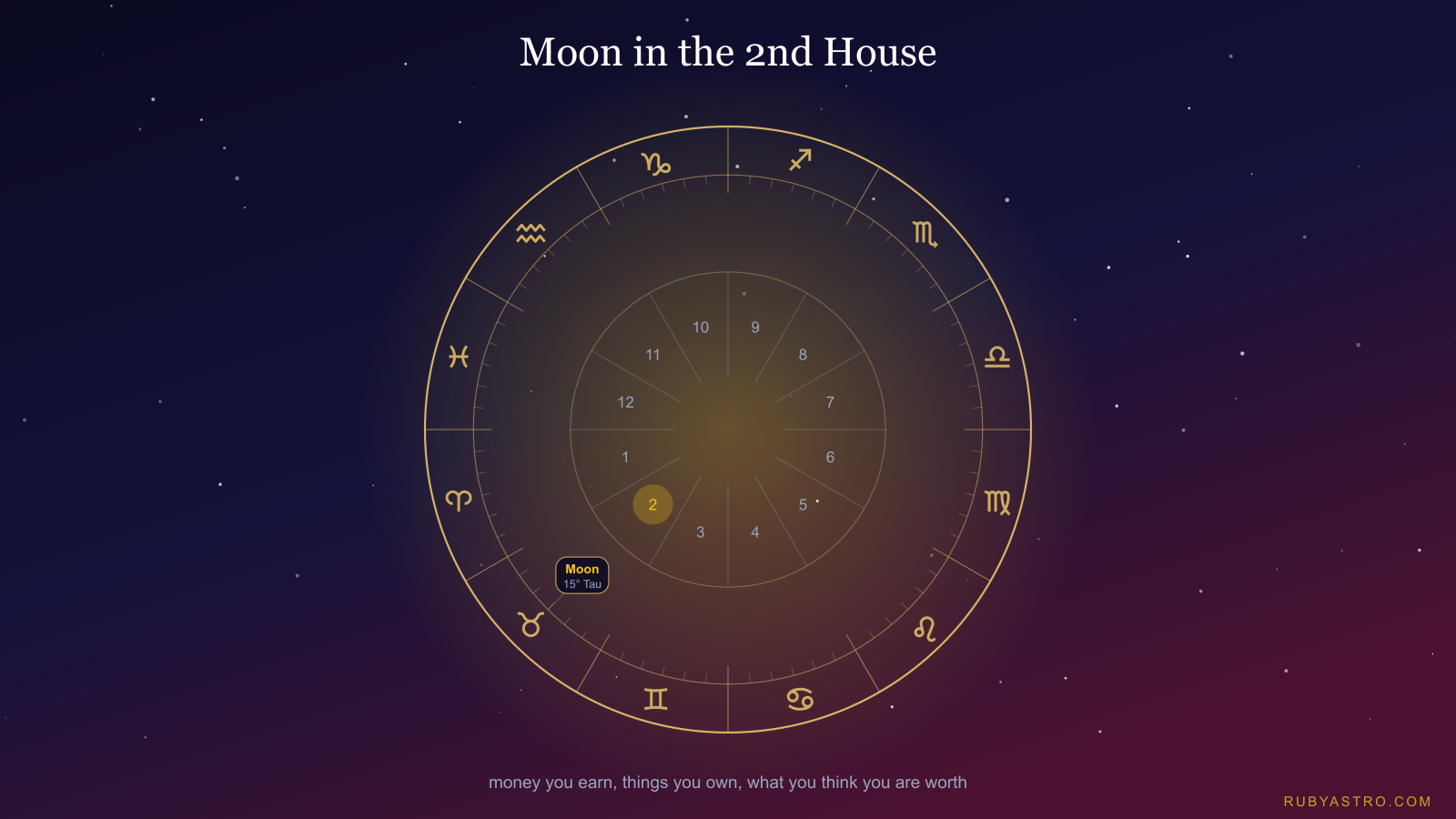 Planets in Houses
Moon in the second house puts feelings, needs and home into the department of money and values. Here is what it does, where it strains, and which sign that means for your rising sign.
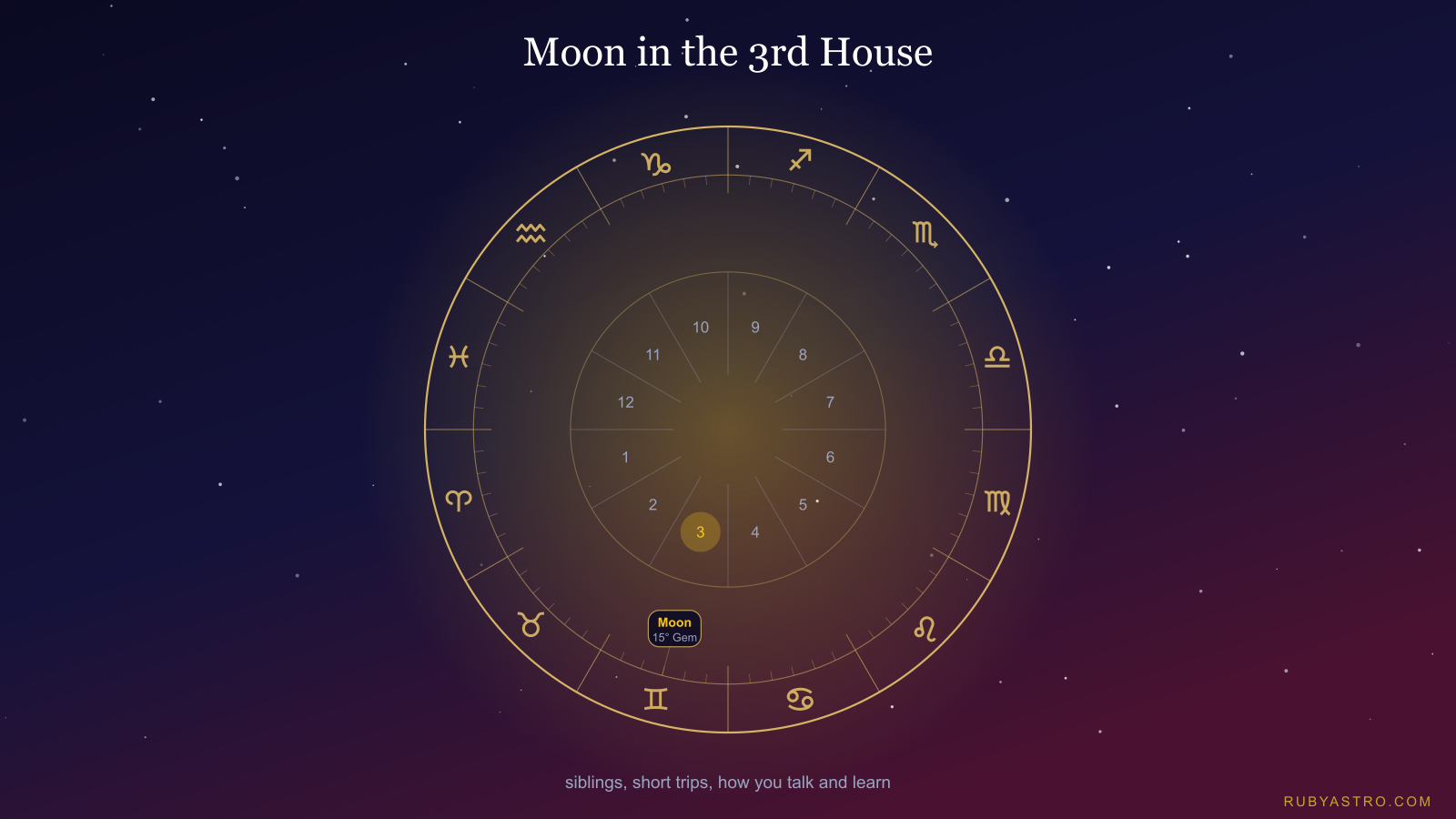 Planets in Houses
Moon in the third house puts feelings, needs and home into the department of communication and siblings. It is also the house Moon traditionally rejoices in. Here is what it does, where it strains, and which sign that means for your rising sign.
 Tarot
The Moon means confusion, fear, imagination. What it means upright and reversed, the four ways readers handle reversals, and the Pisces attribution the Golden Dawn gave it.
 Tarot
The Sun means clarity, success, visibility. What it means upright and reversed, the four ways readers handle reversals, and the Sun attribution the Golden Dawn gave it.
 Tarot
The Four of Cups means indifference, withdrawal, the missed offer. What it means upright and reversed, the four ways readers handle reversals, and the Moon in Cancer attribution behind it.