The Saturn Return: The Real Ages and What It Means
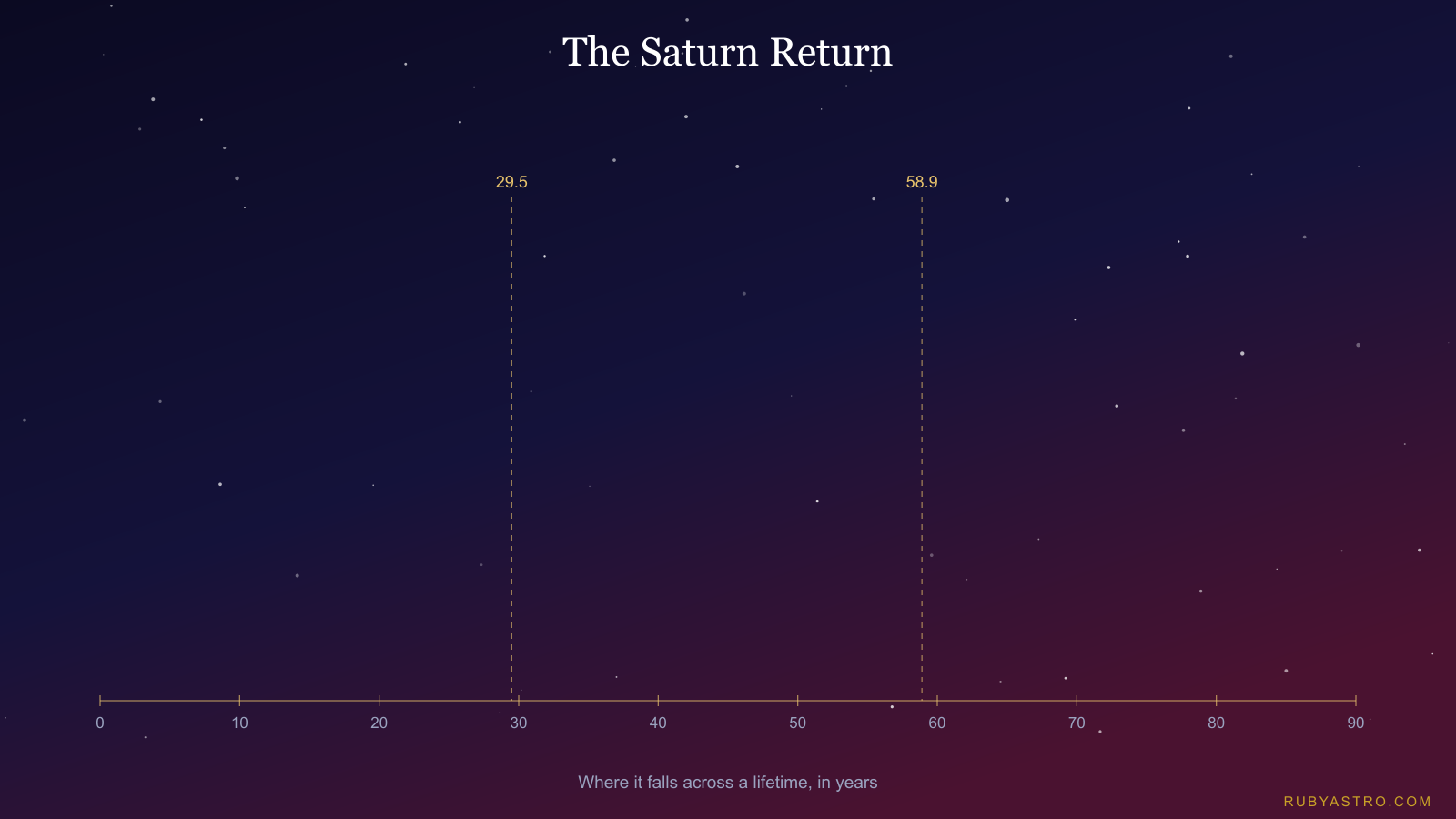
The Saturn Return happens at 29.5, then 58.9, then 88.4, on a cycle of 29.457 years. The arithmetic behind the ages, what the tradition reads into it, and how to check it against your own life.
The RubyAstro TeamPublished September 11, 2026Dates checked September 11, 20264 min read
The Saturn Return: 29.5, then 58.9, then 88.4.
The short answerThe Saturn Return happens at 29.5, then 58.9, then 88.4. Saturn comes back to the degree it held when you were born, on a cycle of 29.457 years. It is read as the classic reckoning. What was built on an unsound footing gives way, and what was built properly gets heavier and stays.
The arithmetic
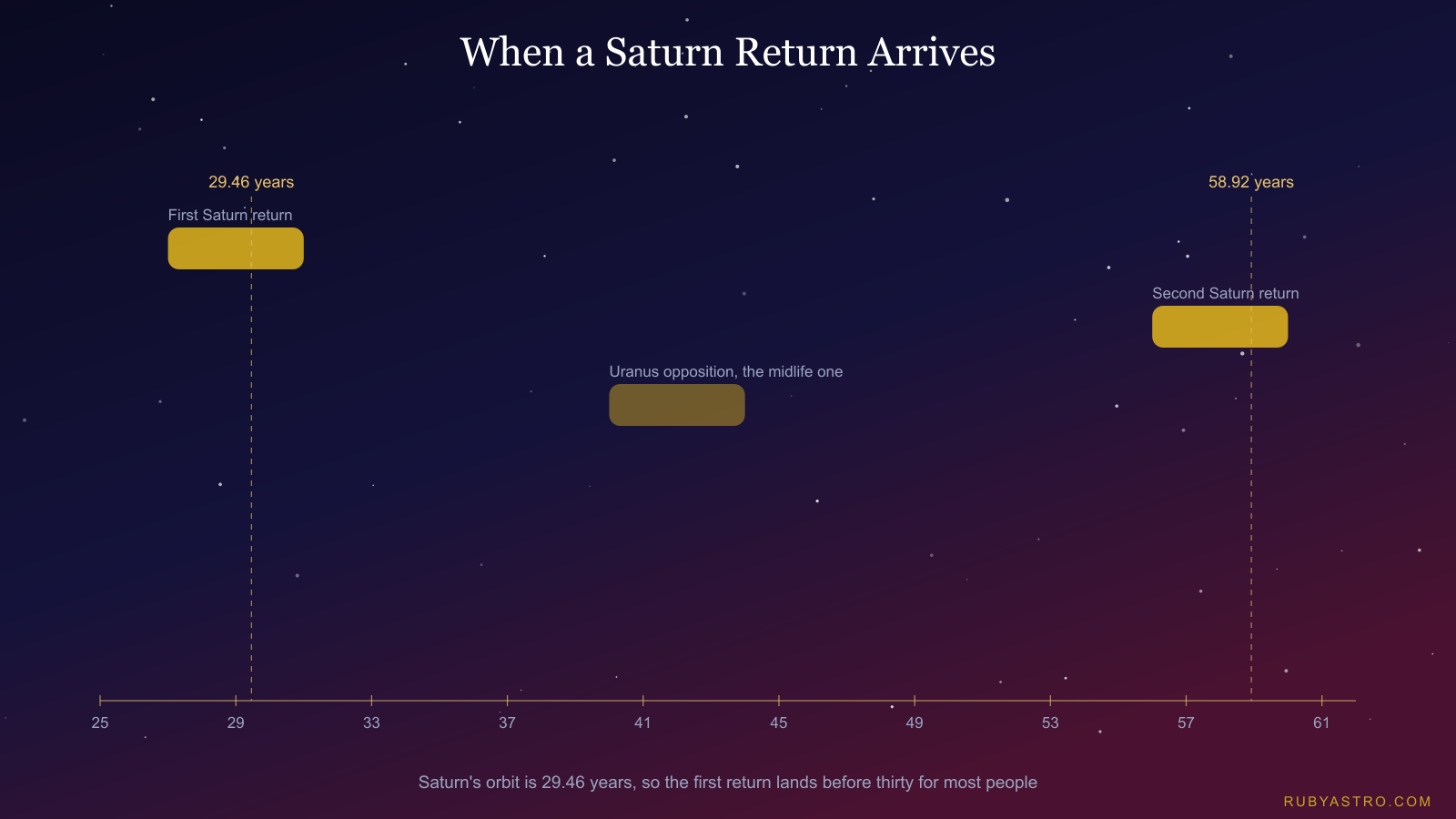
Saturn comes back to the degree it held when you were born. The cycle is 29.457 years, and that figure is the real orbital period rather than a rounded one. The difference matters more than it sounds: a Saturn return at 29.5 rather than at thirty means it starts while people are still expecting to have another year.
The first one is the famous one, and it arrives at 29 and a half rather than at thirty: the figure gets rounded in popular writing and the rounding loses the point, which is that it starts before most people are expecting it. The second, at 58.9, gets almost no attention and is reported by the people who have had both as the harder of the two.
Why these ages and not others
There is nothing mystical about the arithmetic. A planet takes a certain number of years to go round, and the points where it returns to its birth position, reaches the opposite point, or reaches ninety degrees either side are fixed fractions of that. Saturn's 29.457 years gives a return at 29.5, an opposition at 14.7, and squares at 7.4 and 22.1. Those are divisions, not predictions.
The real periods, and what they give
Cycle
Period
Return
Opposition
Jupiter
11.862 years
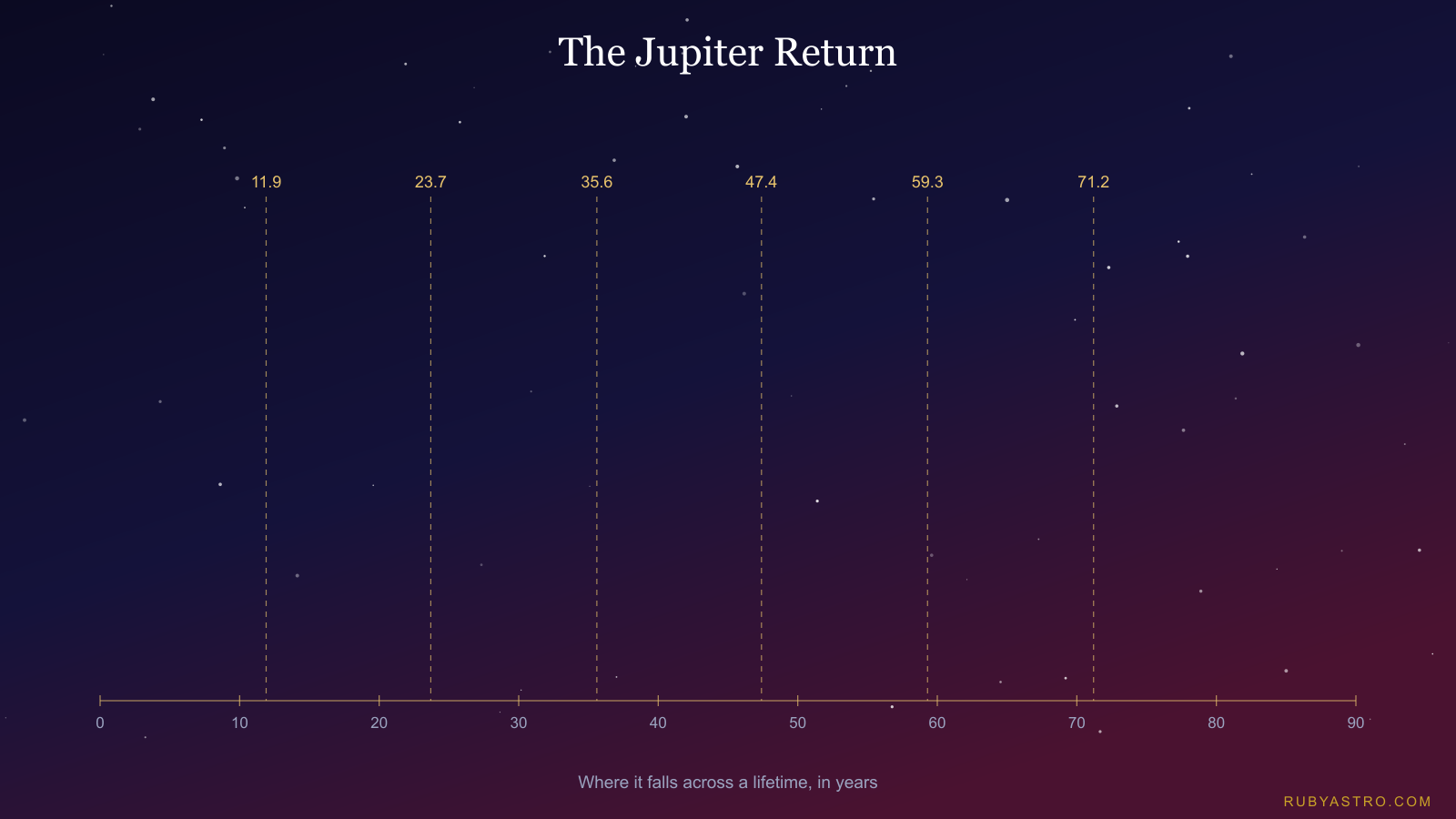
11.9, 23.7, 35.6
5.9, 17.8, 29.7
Saturn
29.457 years
29.5, 58.9
14.7, 44.2
Lunar nodes
18.6 years
18.6, 37.2, 55.8
9.3, 27.9, 46.5
Chiron
50.42 years
about 50.4
about 25
Uranus
84.02 years
84
42
That table is the whole of the life-cycle framework. Everything written about Saturn returns and midlife crises sits on top of five numbers, and the numbers are checkable.
What the saturn return is read as
The classic reckoning. What was built on an unsound footing gives way, and what was built properly gets heavier and stays. The tone depends on where the planet sits in your own chart and what it touches on the way, which is the part a general page cannot tell you.
Worth being careful about one thing. These ages line up with thresholds that most lives contain anyway: finishing education, settling down, the realisation in the early forties that some doors have closed. Whether the planet describes that or merely coincides with it is a real question, and the honest answer is that a cycle which matches ordinary human development is harder to use as evidence, not easier.
How to check it against your own life
Work out when yours fell or falls. For the saturn return that is 29.5, then 58.9, then 88.4.
Write down what was actually happening then, before reading any description of what should have been.
Compare. If the theme is there, the technique is describing something in your life. If it is not, that is a result too.
Look at the next one. Most of these come round more than once, and knowing when is more useful than knowing what somebody says it means.
What a life cycle cannot doIt gives you a date, not an event. Nothing in any of these predicts a divorce, a diagnosis, a promotion or a loss, and a reading that tells you one is coming has left the technique behind. What these cycles describe is a rhythm, and the useful question is always what you intend to do with the period rather than what it is going to do to you.
What else is happening at the same age
These cycles do not queue politely. Several of them land close together, and the periods people remember as difficult are usually the ones where two or three overlap rather than any single transit doing the work.
Where the cycles cluster
Age
What arrives together
Why it is remembered
about 7
Saturn square
The first threshold a child is held to
about 14 to 15
Saturn opposition, nodal reversal nearby
Adolescence, which needs no astrology to explain
about 21 to 24
Uranus square, Saturn square, Jupiter return
Three at once, which is why the early twenties feel like that
about 29 to 30
Saturn return, progressed new moon
The most written about stretch in astrology
about 37 to 38
Nodal return, Jupiter return nearby
A change of direction rather than of circumstance
about 42 to 44
Uranus opposition, then Saturn opposition
The two together are what midlife crisis describes
about 50
Chiron return
Once in a lifetime, and the only one that is
about 58 to 59
Second Saturn return, progressed new moon
Reported by those who have had both as the harder one
At 29.5, then 58.9, then 88.4. The cycle is 29.457 years.
What does the saturn return mean?
The classic reckoning. What was built on an unsound footing gives way, and what was built properly gets heavier and stays.
Why is it at that age exactly?
Because it is a fixed fraction of a real orbital period. Saturn comes back to the degree it held when you were born, and 29.457 years is how long that takes.
Does everybody get one?
Yes, at the same ages, because the periods are the same for everybody. What differs is where the planet sits in your own chart and what it touches.
RubyAstro writes about astrology for reflection and self-understanding. Nothing here is medical, legal or financial advice, and none of it is a prediction of events. Read our full disclaimer.
 Your Age in Astrology