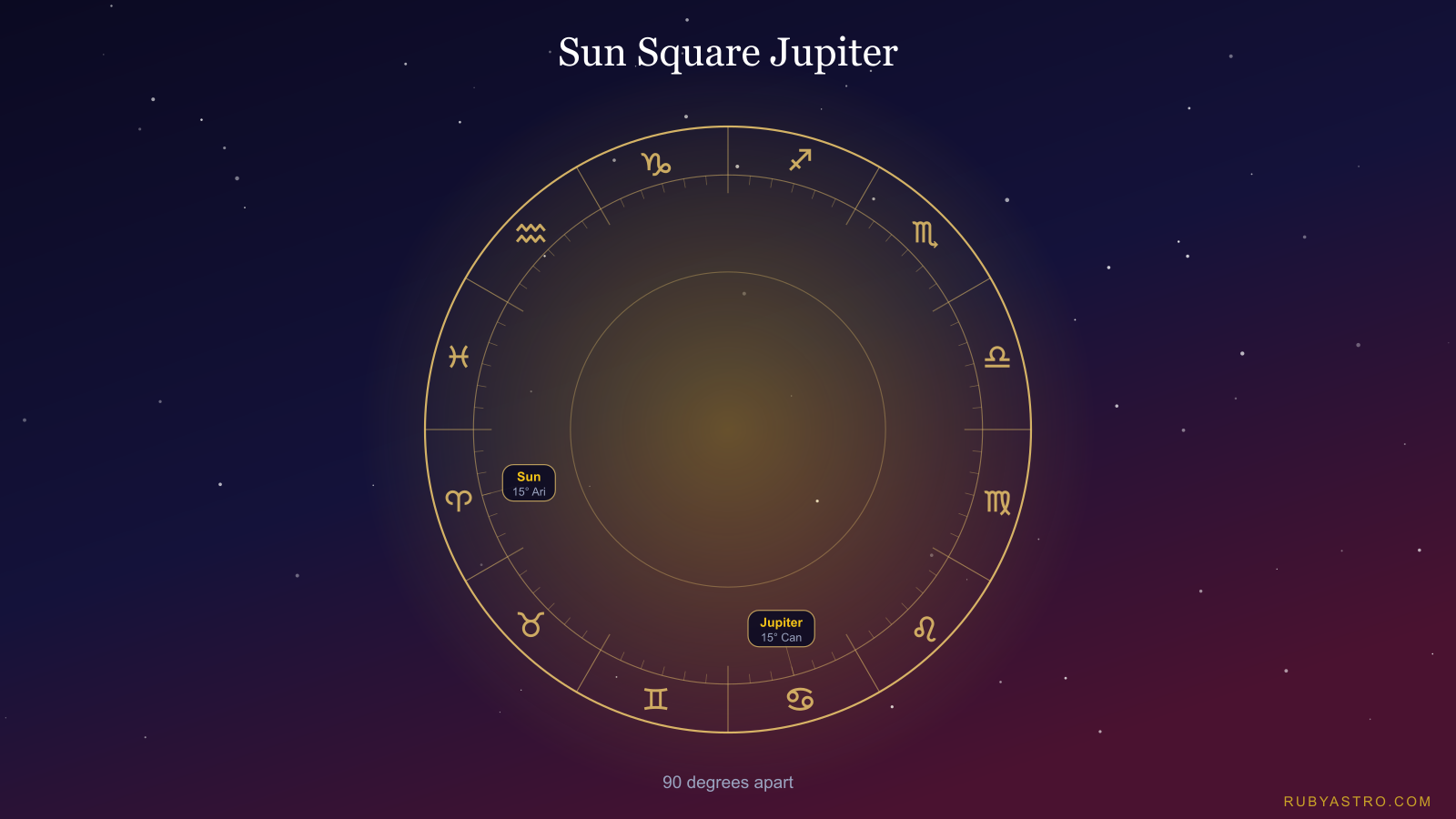
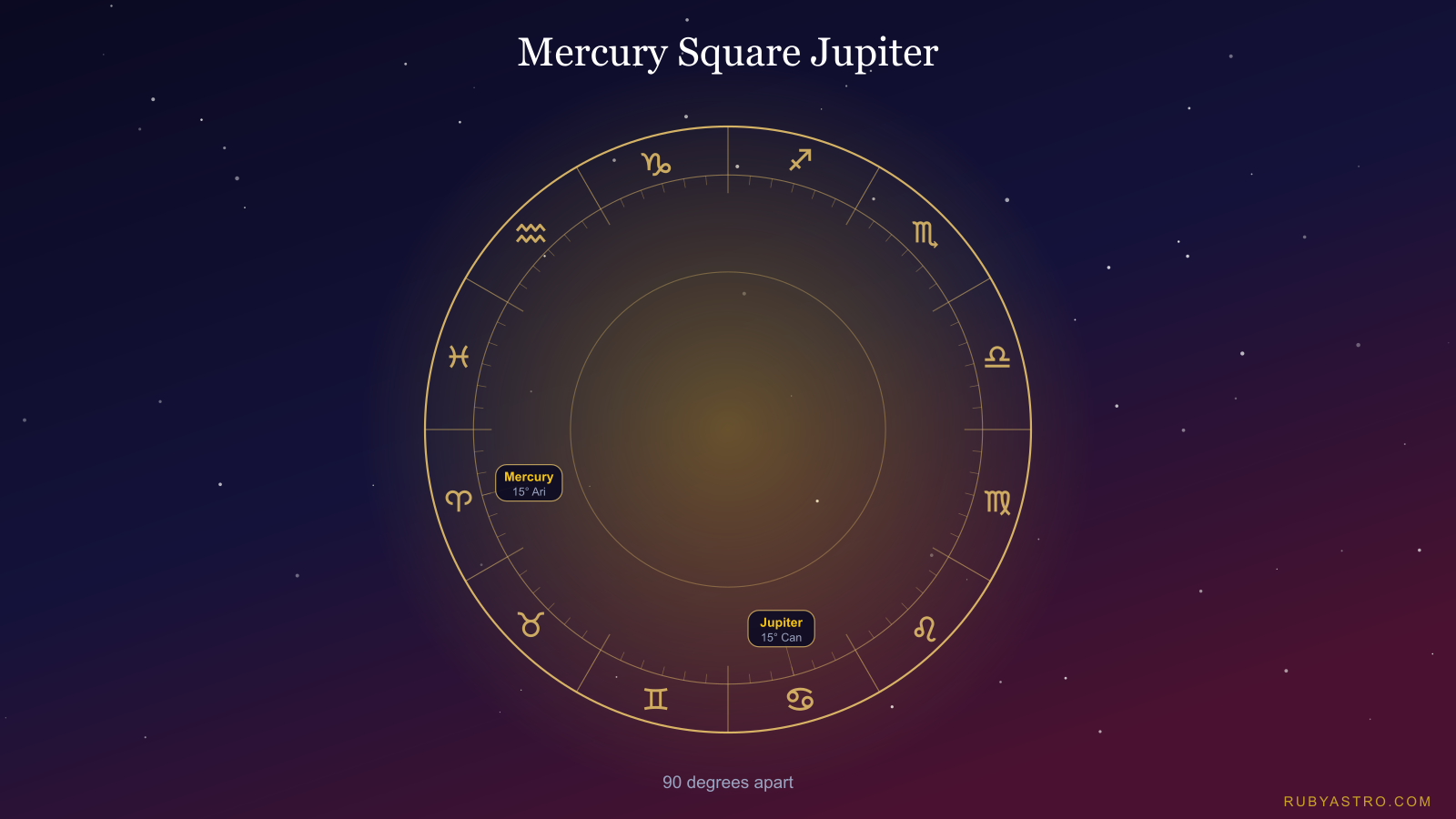
Mercury square Jupiter puts the two 90 degrees apart. Mercury governs thinking, speaking and learning, Jupiter governs growth, luck and belief, and the pairing is about the mind and its appetite, which produces either a genuinely broad thinker or somebody who skips the detail. Here is what the angle does to it.
The RubyAstro TeamPublished November 11, 2026Dates checked November 11, 20264 min read
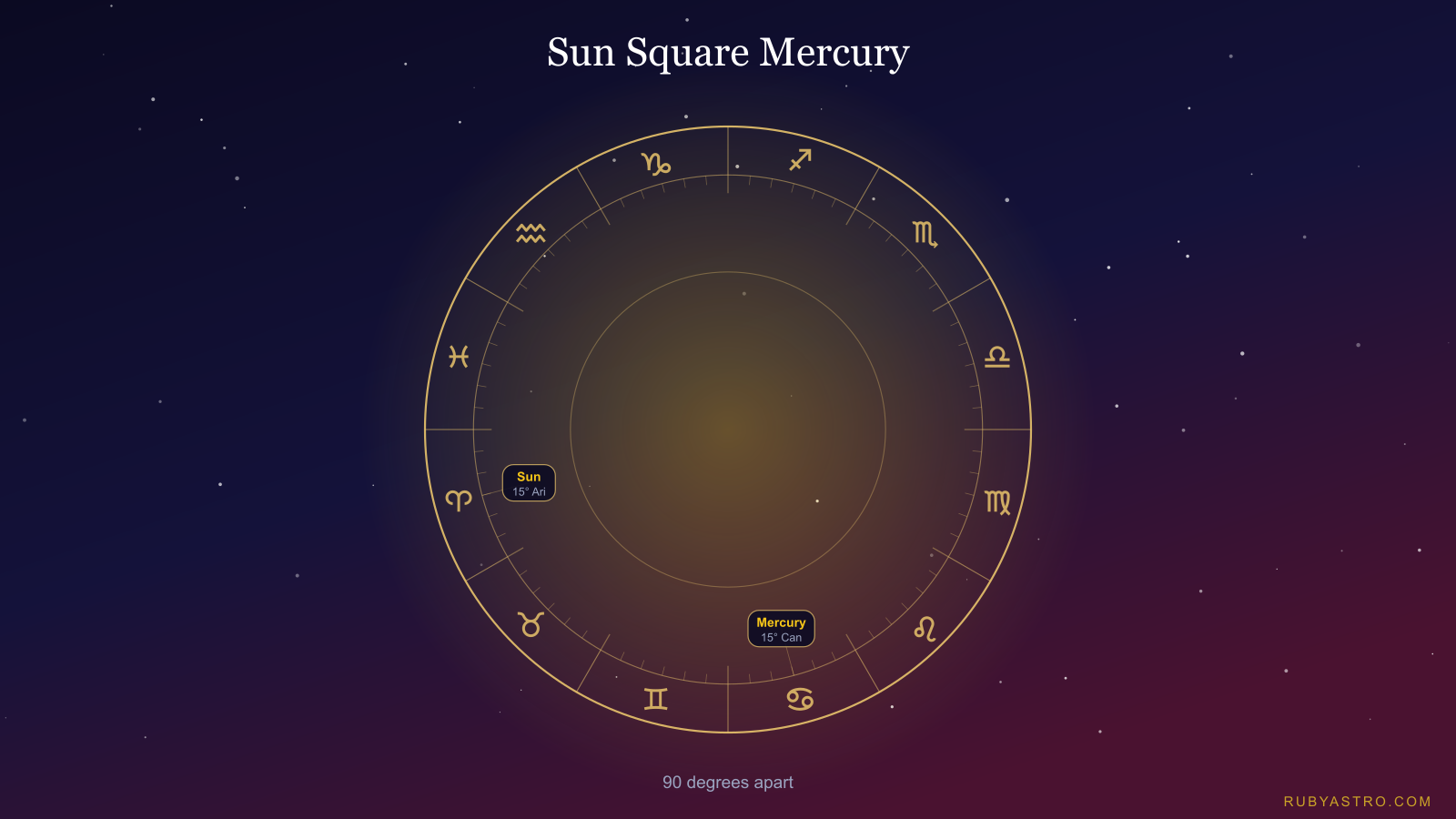
Mercury square Jupiter: 90 degrees apart. The angle is the relationship.
The short answerMercury square Jupiter means the two planets sat 90 degrees apart in your birth chart. Mercury governs thinking, speaking and learning and Jupiter governs growth, luck and belief, so the aspect is about the mind and its appetite, which produces either a genuinely broad thinker or somebody who skips the detail. Square is a friction aspect: two needs that keep interrupting each other.
An aspect is simply the angle between two planets, and the angle is the relationship. Astrologers read 90 degrees the same way whether it turns up between these two planets or any others, which is why the logic here is checkable rather than asserted.
What the two planets want
Mercury is the need to understand and explain. Jupiter is the need for more. Those are different jobs, and in a chart they are done by different parts of a person at the same time.
The subject of this particular pairing is the mind and its appetite, which produces either a genuinely broad thinker or somebody who skips the detail. That is true of any aspect between these two; what changes with the angle is whether the two drives cooperate, ignore each other or collide.
What a square does to it
Squares produce movement. Two planets at ninety degrees keep interrupting each other, and that friction is what makes a person develop. Most genuine competence in a chart comes from a square somewhere.
The cost: It is uncomfortable, repeatedly, and the discomfort does not resolve into anything neat. This is an argument you have with yourself for decades rather than a problem you solve once.
What to actually do with itThe work is to let both planets have their turn rather than picking a favourite. The usual failure is suppressing one of them, which does not remove it, it just delays it.
How tight is tight
Aspects are not on or off. They have an orb, which is how far from exact the angle can be and still count. For squares the usual working orb is up to about 7 degrees, and the closer to exact, the louder the aspect.
How to read the orb on Mercury square Jupiter
Distance from exact
How much it shows
In practice
Under 1 degree
Dominant
One of the defining features of the chart. Other people notice it before you explain anything.
1 to 3 degrees
Strong
Clearly present and recognisable in the description above.
3 to 6 degrees
Present
Real but not loud. Usually recognisable once pointed out.
Beyond 7 degrees
Not counted
Outside the working orb. Astrologers would not read it.
This is not a bad aspect
The hard aspects have a reputation they do not deserve. Squares produce friction, and friction is where development comes from: almost every genuinely capable person has several, and charts made entirely of easy aspects tend to belong to people who never had to build anything. What a square predicts is effort, not misfortune.
The honest summary is that an aspect tells you where the energy goes, not whether your life will be easy. Both kinds are needed, and most charts have plenty of each.
Do you need a birth time for this?
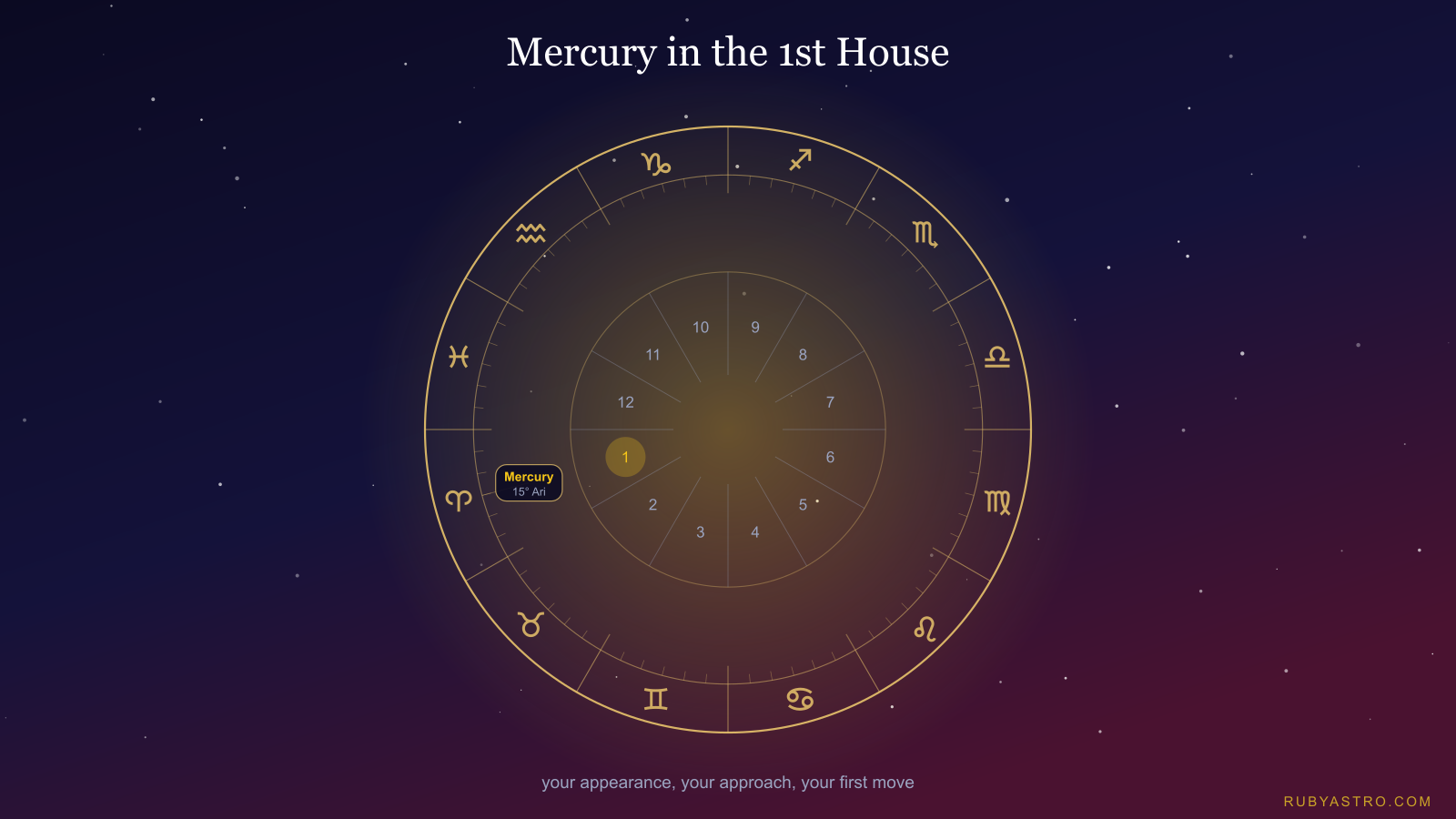
Not for the aspect itself. Mercury and Jupiter both move slowly enough that the angle between them barely changes across a single day, so this aspect is reliable from your birth date alone. What you do need a birth time for is the houses the two planets sit in, which is what turns the aspect from a trait into a part of your life.
Where to read next
The same pair at a different angle is the quickest comparison worth making: Mercury trine Jupiter and Mercury opposition Jupiter describe the same two drives getting along and grinding, which is the clearest way to see what the planets themselves are doing underneath the angle.
The two planets are 90 degrees apart in the chart. Mercury governs thinking, speaking and learning and Jupiter governs growth, luck and belief, so the aspect is about the mind and its appetite, which produces either a genuinely broad thinker or somebody who skips the detail, with two needs that keep interrupting each other.
Is Mercury square Jupiter a good or bad aspect?
It is a hard aspect, which means friction rather than misfortune. Hard aspects are where most development in a chart comes from. The cost is that it is uncomfortable, repeatedly, and the discomfort does not resolve into anything neat. This is an argument you have with yourself for decades rather than a problem you solve once.
How close do the planets have to be?
The usual working orb for a square is up to about 7 degrees. Under a degree it is one of the defining features of the chart; beyond the orb astrologers would not read it at all.
Do I need my birth time?
Not for the aspect itself, since both planets move slowly. You do need one for the houses they fall in.
RubyAstro writes about astrology for reflection and self-understanding. Nothing here is medical, legal or financial advice, and none of it is a prediction of events. Read our full disclaimer.
 Planets in Houses