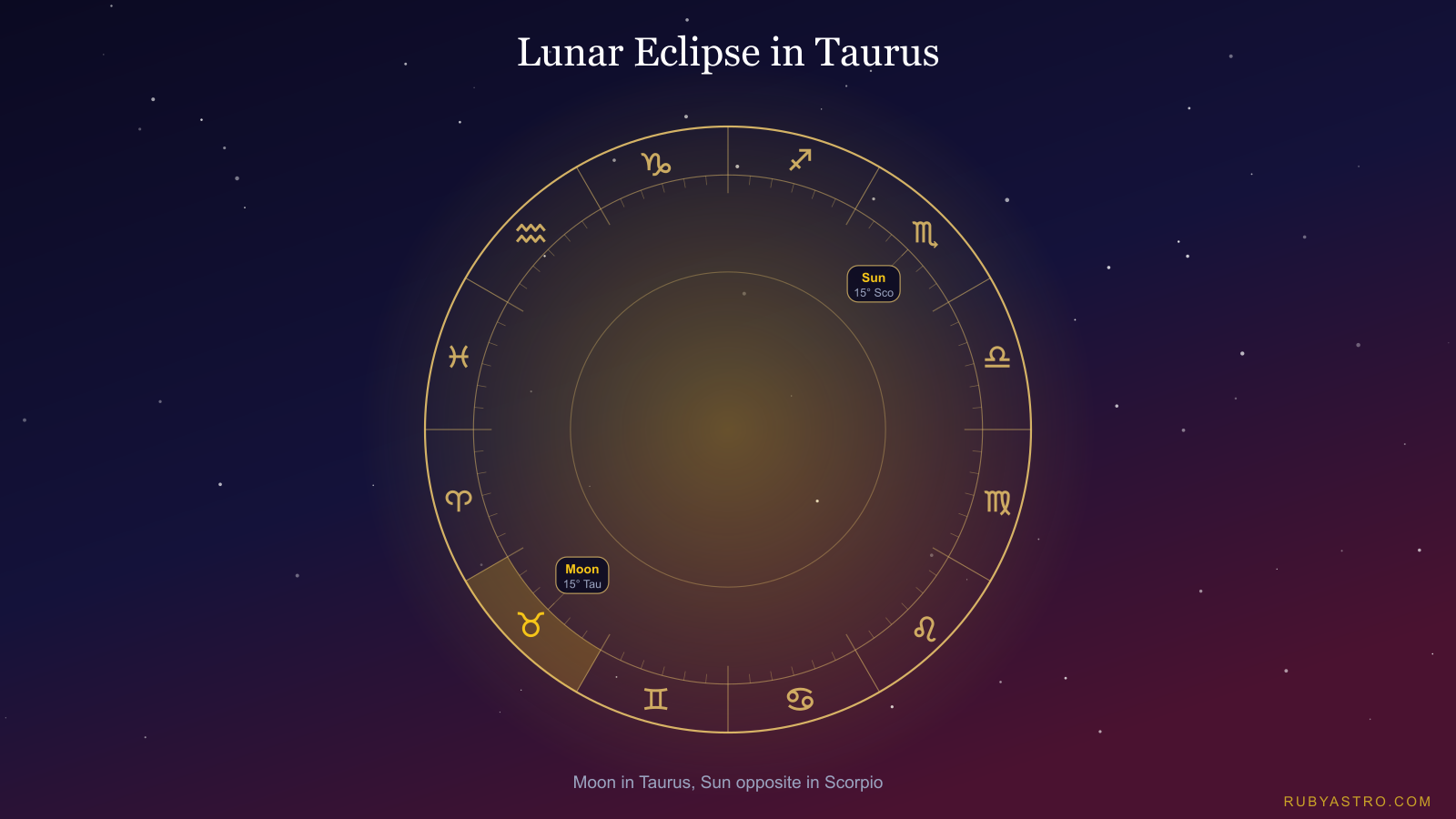
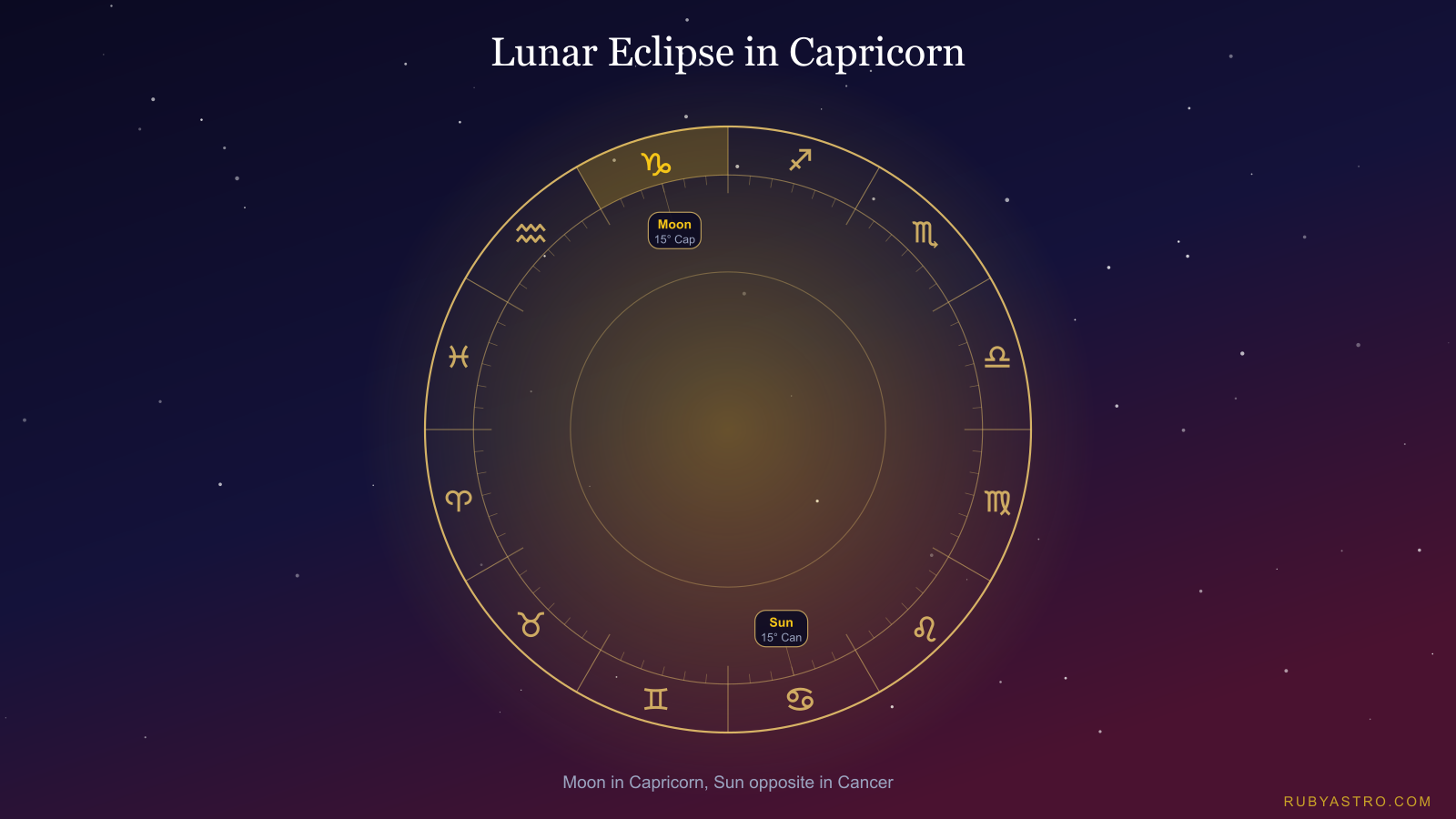
A lunar eclipse in Capricorn points at career, authority and what you are building. Every occurrence with exact dates and degrees, what an eclipse physically is, and the 18-year cycle that lets you check it against your own past.
The RubyAstro TeamPublished August 31, 2026Dates checked August 31, 20266 min read
Lunar Eclipse in Capricorn: career, authority and what you are building.
The short answerA lunar eclipse in Capricorn is a full moon close enough to a lunar node for the Earth's shadow to fall across the Moon, falling in the part of the zodiac that covers career, authority and what you are building. It reads as a culmination, and specifically one that is no longer avoidable. Lunar eclipses are the ones people describe as endings. The next one is July 18, 2027, at 25°58' Capricorn.
Every lunar eclipse in Capricorn, 1990 to 2050
Eclipses arrive in seasons, roughly every six months, and the seasons move backwards through the zodiac along with the lunar nodes. That means Capricorn gets a run of them every nine years or so rather than one a year. These are computed from the ephemeris.
Lunar Eclipses in Capricorn
Date
Degree
Kind
June 26, 1991
5°08' Capricorn
Penumbral
July 16, 2000
24°20' Capricorn
Total
July 5, 2001
13°35' Capricorn
Partial
June 24, 2002
3°03' Capricorn
Penumbral
July 7, 2009
15°33' Capricorn
Penumbral
June 26, 2010
4°50' Capricorn
Partial
July 16, 2019
24°00' Capricorn
Partial
July 5, 2020
13°30' Capricorn
Penumbral
July 18, 2027
25°58' Capricorn
Penumbral
July 6, 2028
15°16' Capricorn
Partial
June 25, 2029
4°50' Capricorn
Total
July 16, 2038
23°56' Capricorn
Penumbral
July 17, 2046
25°42' Capricorn
Partial
July 7, 2047
15°17' Capricorn
Total
June 25, 2048
5°06' Capricorn
Partial
The past ones are the useful column. If you want to know whether eclipses mean anything in your own life, look up what was happening around July 5, 2020 and the ones before it. A pattern you can find yourself is worth more than any description a page can give you.
What a lunar eclipse actually is
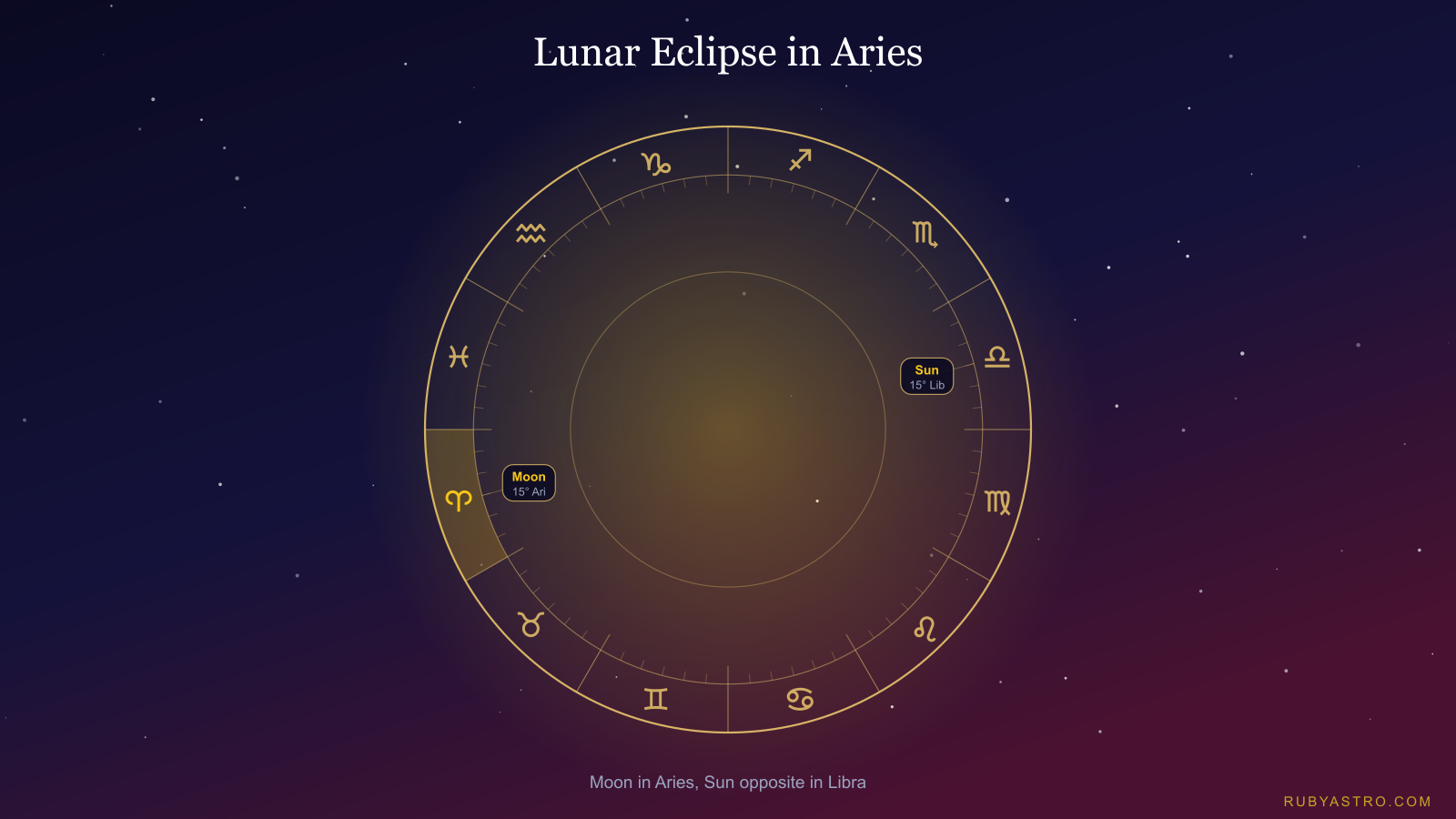
At a lunar eclipse the Earth comes between the Sun and the Moon and its shadow falls across the Moon's face. That needs a full moon, and again it needs the alignment to be close to a node. The Moon usually turns a deep copper colour rather than going dark, because sunlight bends through the Earth's atmosphere and the blue is scattered out of it, which is the same reason a sunset is red.
Those two crossing points are the lunar nodes, and they are the whole reason eclipses are rare. What the nodes are is covered here. The nodes move backwards about nineteen degrees a year, which is why eclipse season drifts earlier each year and why the signs they fall in change every eighteen months.
Why eclipses repeat
Eclipses are not scattered. They come in families called saros series, each running for about twelve to fifteen hundred years, and inside a series an eclipse repeats every 18 years and 11 days. That period is the saros: the time it takes for the Moon's phase cycle, its distance cycle and its node cycle to come back into step, which they do to within a few hours.
The Babylonians worked this out from records alone, without knowing why it was true, and could predict lunar eclipses with it. The one gap in the method is that each repeat lands about eight hours later, so the Earth has turned a third of the way round and the eclipse is visible from a different part of the world. Three saros periods, 54 years, brings it back to roughly the same longitude.
The practical consequence for a reader: if an eclipse falls on something in your chart, go back 18 years and 11 days and look at what was happening. That is the closest thing astrology has to a repeatable experiment, and it costs nothing to check.
Why Capricorn changes what it is about
Capricorn is Earth and Cardinal, ruled by Saturn, and it covers career, authority and what you are building. An eclipse here points there. Because eclipses always come in pairs across an axis, one in Capricorn is part of a run that also touches Cancer, and the tradition reads the two ends together rather than separately.
A lunar eclipse is a full moon, so it is read as a culmination. The common description is that something you had been managing stops being manageable, which is uncomfortable and is frequently the point.
Which part of your life it lands in
The sign is shared by everybody. The house is not, and the house is what turns an eclipse from a news item into something that happened to you. On whole sign houses it follows directly from your rising sign.
Where a lunar eclipse in Capricorn falls, by rising sign
Rising sign
House
So it is about
Aries
10th
career and reputation
Taurus
9th
travel, study and belief
Gemini
8th
shared money, intimacy and endings
Cancer
7th
partnership, marriage and open conflict
Leo
6th
daily work, health and routine
Virgo
5th
romance, children and creative work
Libra
4th
home, family and property
Scorpio
3rd
talking, learning, siblings, short trips
Sagittarius
2nd
money you earn and what you own
Capricorn
1st
you, your body, how you come across
Aquarius
12th
rest, grief and what nobody sees
Pisces
11th
friends, groups and hopes
Because eclipses come in pairs across an axis, the opposite house is involved too. A lunar eclipse in your 10th house is a career matter with something at home on the other end of it, and the tradition reads both rather than one.
Whether this one is yours
Only if the degree is close to something in your own chart, within a few degrees. The next one falls at 25°58' Capricorn, so look for anything of yours near that degree. That is a much higher bar than most eclipse writing admits, and it is why most eclipses pass without anybody noticing anything.
What an eclipse does and does not doAn eclipse is a shadow. It does not emit anything, it does not affect the body, and the only documented health risk is looking at a solar one without proper filters, which damages the retina permanently and painlessly. Astrologically the honest claim is that an eclipse is a lunation turned up: faster, less optional, and with effects that tend to show up over months rather than days. It matters to you personally only if its degree is close to something in your own chart. Everything else is a shared calendar entry.
How to use an eclipse
Check the degree against your chart. If nothing of yours is within about three degrees, this is a date rather than an event.
Do not start anything new on one. The traditional advice is to let an eclipse pass before acting, on the grounds that what it reveals is not usually complete at the time.
Look back 18 years and 11 days. That is the same eclipse in the same saros series, and whatever it touched then it is touching again.
Give it months, not days. Eclipse effects are consistently reported as unfolding over the following half year rather than on the day.
Questions people ask
When is the next lunar eclipse in Capricorn?
July 18, 2027, 12:02 PM ET, at 25°58' Capricorn.
What does a lunar eclipse in Capricorn mean?
It points at career, authority and what you are building, and reads as a culmination, and specifically one that is no longer avoidable. Lunar eclipses are the ones people describe as endings.
Why are there not eclipses every month?
Because the Moon's orbit is tilted about five degrees, so at most new and full moons it passes above or below the line. An eclipse needs the alignment to happen near one of the two points where the orbits cross.
Does an eclipse affect everyone?
No. It matters to you personally only if its degree falls close to something in your own birth chart.
RubyAstro writes about astrology for reflection and self-understanding. Nothing here is medical, legal or financial advice, and none of it is a prediction of events. Read our full disclaimer.
 Retrogrades