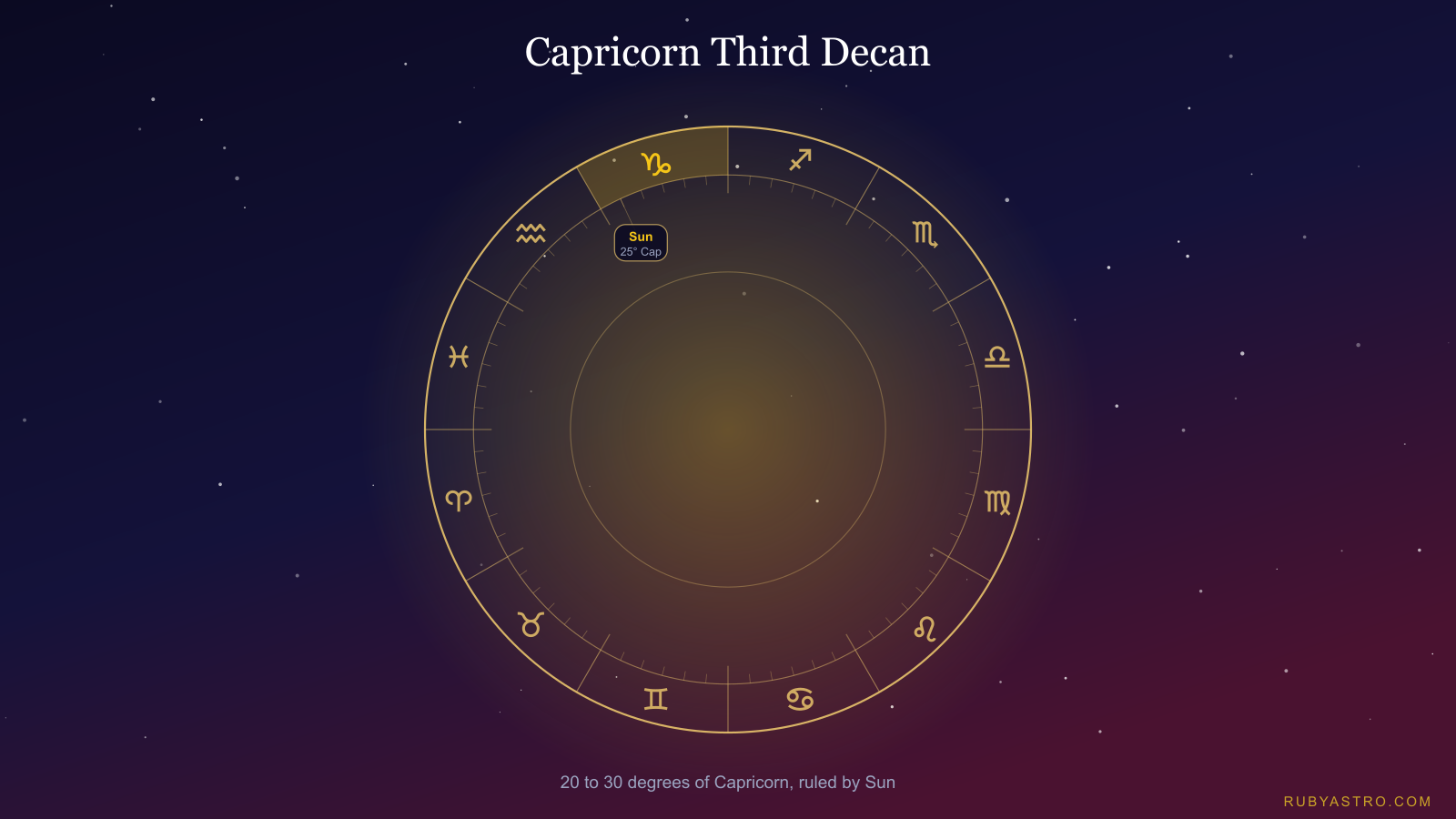
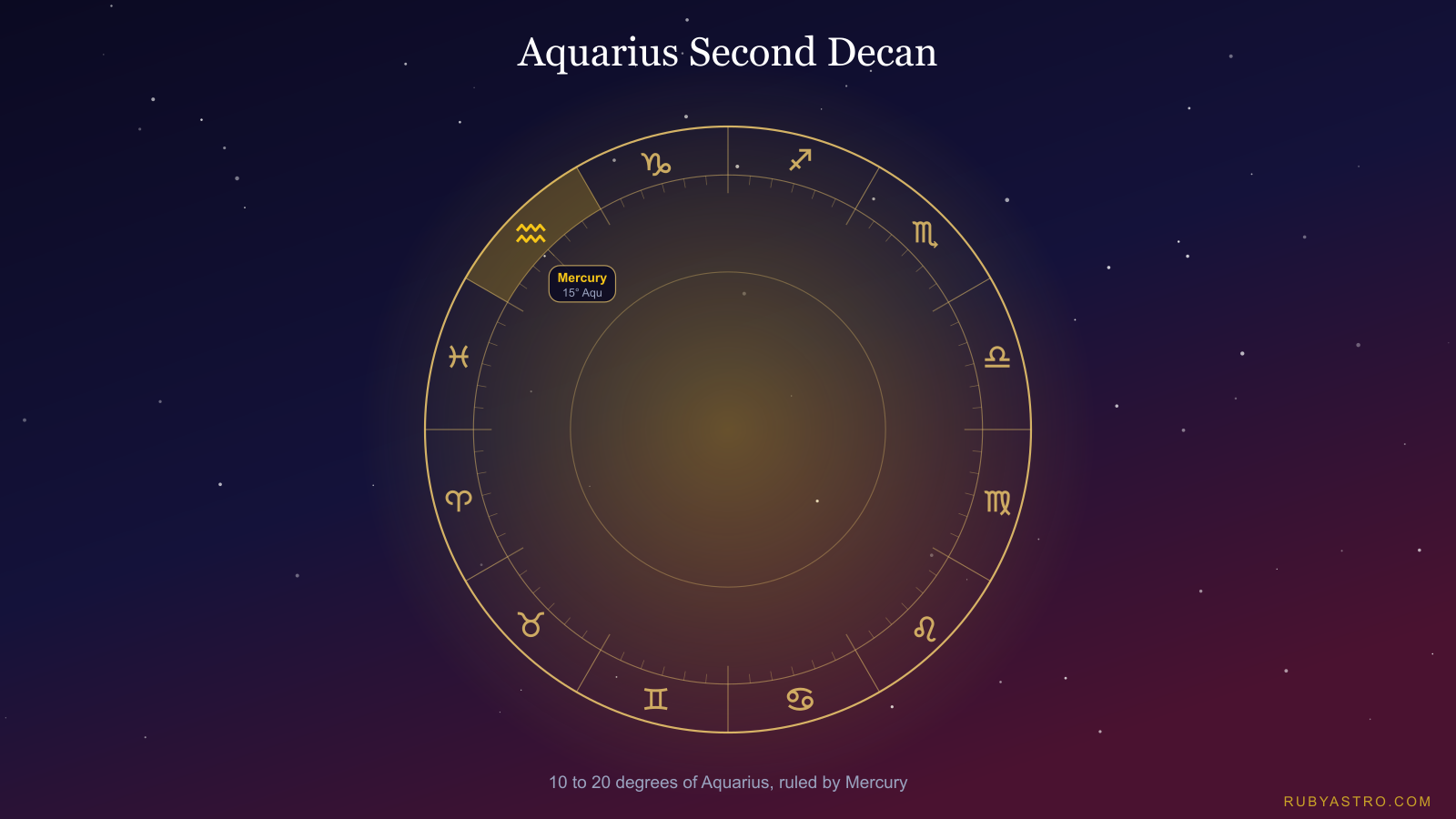
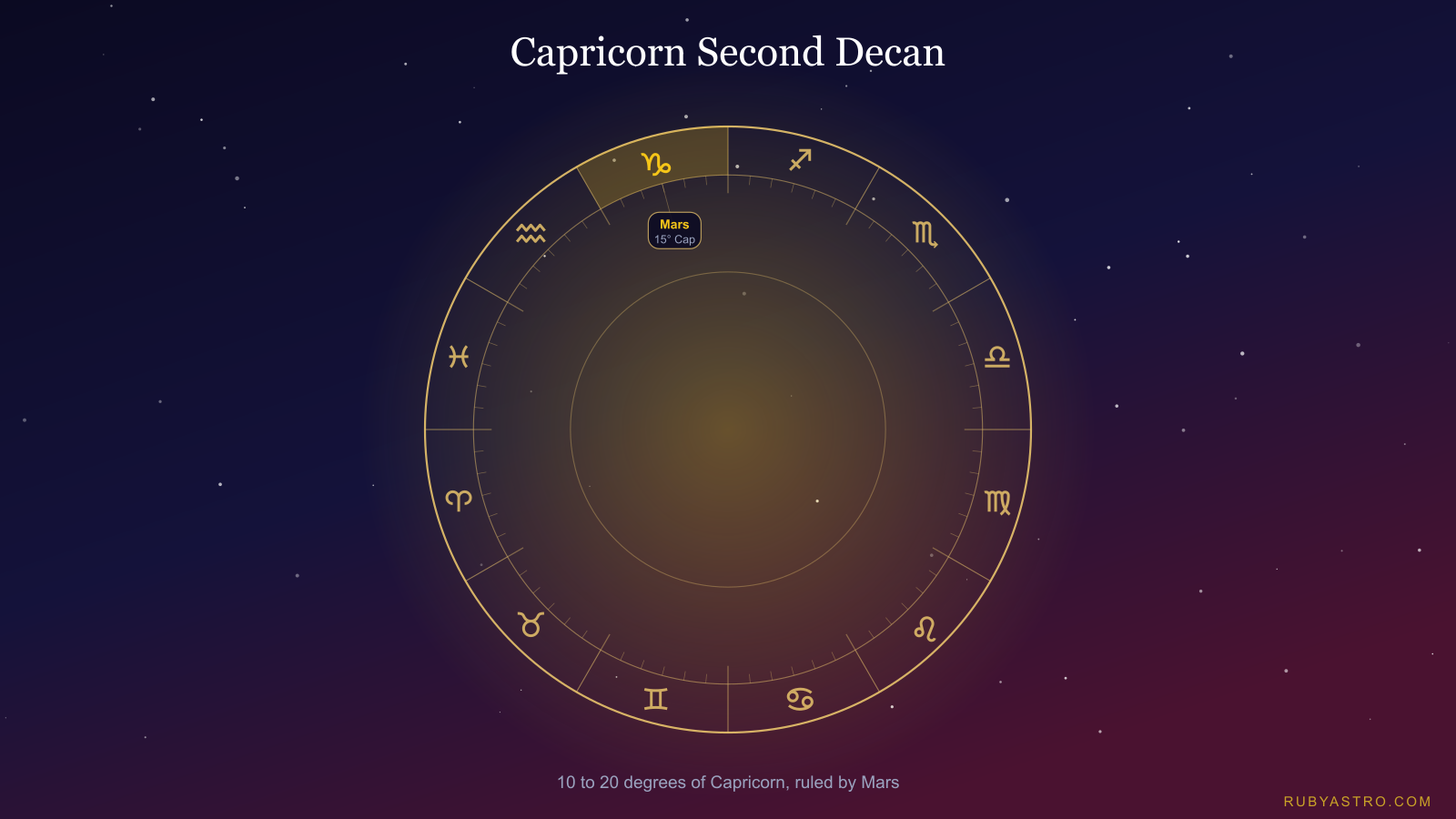
The second decan of Capricorn runs 10 to 20 degrees, roughly January 1 to January 9, ruled by Mars. What a decan is, where the idea came from, and the tarot card that shares these ten degrees.
The RubyAstro TeamPublished August 15, 2026Dates checked August 15, 20265 min read
Capricorn Second Decan: 10 to 20 degrees of Capricorn, ruled by Mars.
The short answerThe Capricorn second decan is 10 to 20 degrees of Capricorn, roughly January 1 to January 9. Its ruler is Mars, which adds heat, urgency and a willingness to fight for it to the sign. In the tarot the same ten degrees are the Three of Pentacles.
The dates
The Sun covers about a degree a day, so a decan takes roughly ten days. These are the calendar dates the Sun spends in the second decan of Capricorn, computed across 1930 to 2035.
When the Sun is in the Capricorn second decan
Degrees
10 to 20 of Capricorn
Dates
January 1 to January 9
Length
9 days
Ruler
Mars
Sign ruler
Saturn
Tarot card
Three of Pentacles
These dates are stable: neither edge crosses into a neighbouring decan in the years surveyed. January 1 and January 9 each have a page of their own.
What a decan is, and where the idea came from
A decan is a third of a sign: ten degrees out of thirty, which the Sun crosses in about ten days. Twelve signs give thirty-six of them, and each one carries its own planetary ruler on top of the sign's. That makes a decan roughly three times more specific than a Sun sign while still needing nothing but a birth date.
The idea is older than the zodiac it now divides. The Egyptians used thirty-six groups of stars, each rising about forty minutes after the last, to tell the time at night. Ten of them were visible across a night, which is one of the threads that led to the day being divided into twenty-four hours rather than some rounder number. The decans were on coffin lids and temple ceilings a long time before anybody attached planets to them.
The planetary rulers came later, from Hellenistic astrology, and they run in what is called the Chaldean order: Saturn, Jupiter, Mars, Sun, Venus, Mercury, Moon, which is the planets ranked by apparent speed from slowest to fastest. Starting at the first ten degrees of Aries and counting that sequence forward one decan at a time gives every decan its ruler, and it comes out the same every time because it is arithmetic rather than opinion.
Capricorn through Mars
Capricorn is Earth and Cardinal, ruled by Saturn, and the traits usually attached to it are responsible, ambitious, dry humored, reserved and durable. Every Capricorn has that. What the second decan adds is Mars, and the result is a Capricorn who runs sharper and less patient.
In practice the pairing shows as doing it now and apologising later. A Capricorn from this decan is recognisably Capricorn, with heat, urgency and a willingness to fight for it laid over the top. Compared with the other two thirds of the sign it is the Mars version, and the difference is usually obvious once you know to look for it.
The three decans of Capricorn side by side
Decan
Degrees
Ruler
What it adds
First
0 to 10
Jupiter
scale, optimism and a taste for the bigger version
Second (this one)
10 to 20
Mars
heat, urgency and a willingness to fight for it
Third
20 to 30
Sun
confidence, visibility and a wish to be seen doing it
That table is the argument for decans in one block. Three people can all be Capricorn and be running it through Jupiter, Mars and Sun, which is a genuine difference and one a Sun sign on its own throws away.
The tarot card for this decan
The standard English tarot deck was built on this same system. Every pip card from Two to Ten corresponds to one decan, which means the second decan of Capricorn and the Three of Pentacles are two descriptions of one ten-degree stretch of sky.
That correspondence is not decoration and it is not something the tarot borrowed loosely. The Rider deck of 1909 was drawn to a scheme in which the thirty-six pips map onto the thirty-six decans in order, and the card's traditional meaning was derived from the decan's ruler and sign rather than the other way round. Reading the card is another way of reading these ten degrees, and it is frequently the more vivid one.
Mars in Capricorn is the third description of the same thing, this time as a birth chart placement.
If your birthday falls here
Your Sun is in this decan, which narrows it from one sign in twelve to one stretch in thirty-six. Worth doing something with: read the Mars pages as well as the Capricorn ones, because half of what is usually described as your sign is being coloured by a planet most descriptions never mention.
What a decan still cannot doIt narrows your Sun from a thirty-day band to a ten-day one, which is a real improvement and is still only your Sun. Your Moon can change sign inside a single day and your rising sign changes completely every two hours, so neither is anywhere in this. Anybody selling a decan reading as a full picture is selling you one tenth of a chart.
Roughly January 1 to January 9, which is 10 to 20 degrees of Capricorn. The edges move by a day either way between years.
Who rules the second decan of Capricorn?
Mars, from the Chaldean order counting forward from the first decan of Aries. Capricorn itself is ruled by Saturn.
What tarot card is the Capricorn second decan?
The Three of Pentacles. Every pip card from Two to Ten corresponds to one decan, and this is the one.
How do I know which decan I am?
By your birth date, and more precisely by your Sun's degree. The first ten degrees of a sign are the first decan, ten to twenty the second, twenty to thirty the third.
RubyAstro writes about astrology for reflection and self-understanding. Nothing here is medical, legal or financial advice, and none of it is a prediction of events. Read our full disclaimer.
 Astrology Calendar