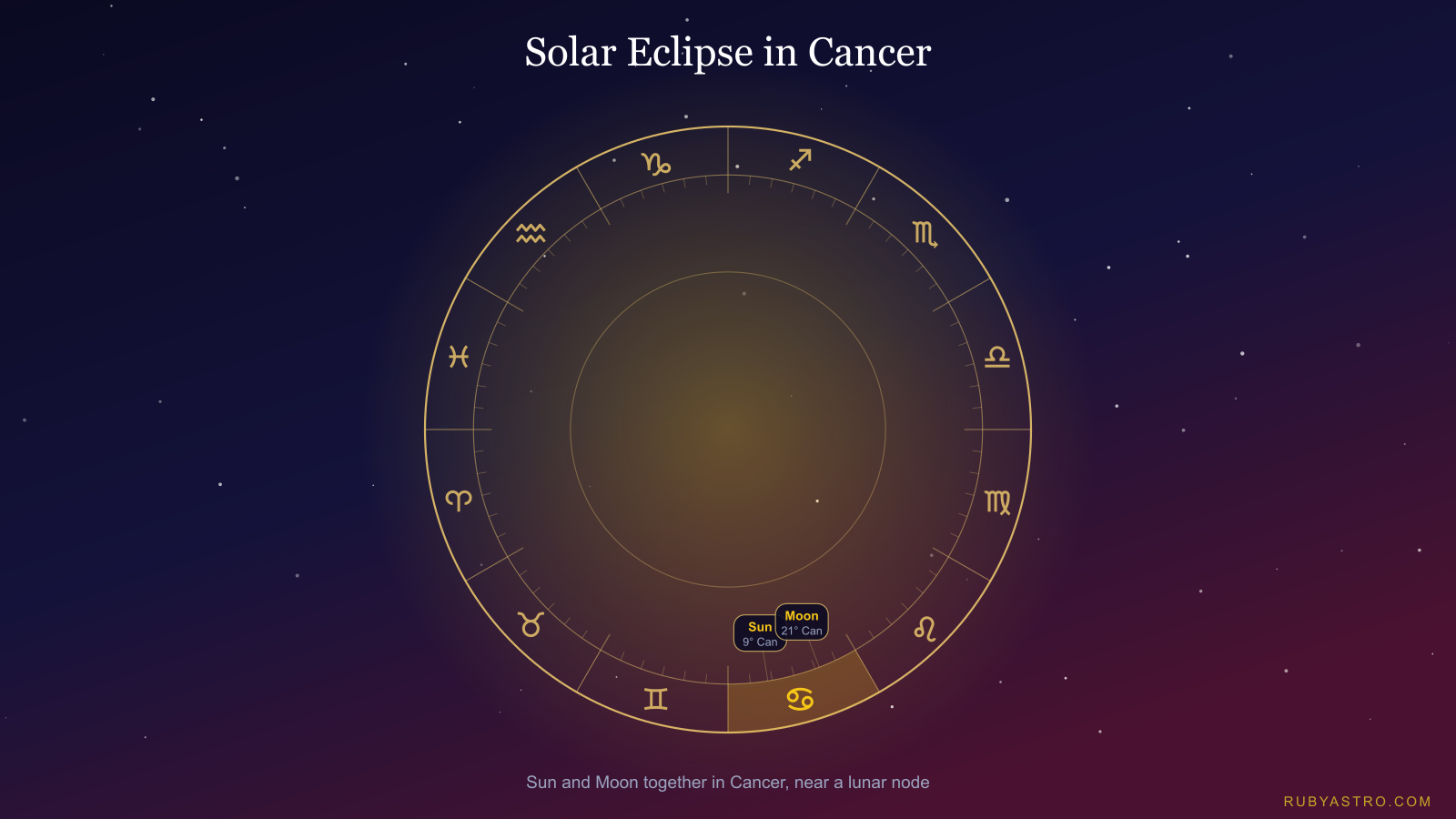
Five eclipses in two seasons, including the longest totality over land this century. Dates, types and the exact degree of each, computed rather than copied.
The RubyAstro TeamPublished August 22, 2026Dates checked August 22, 20264 min read
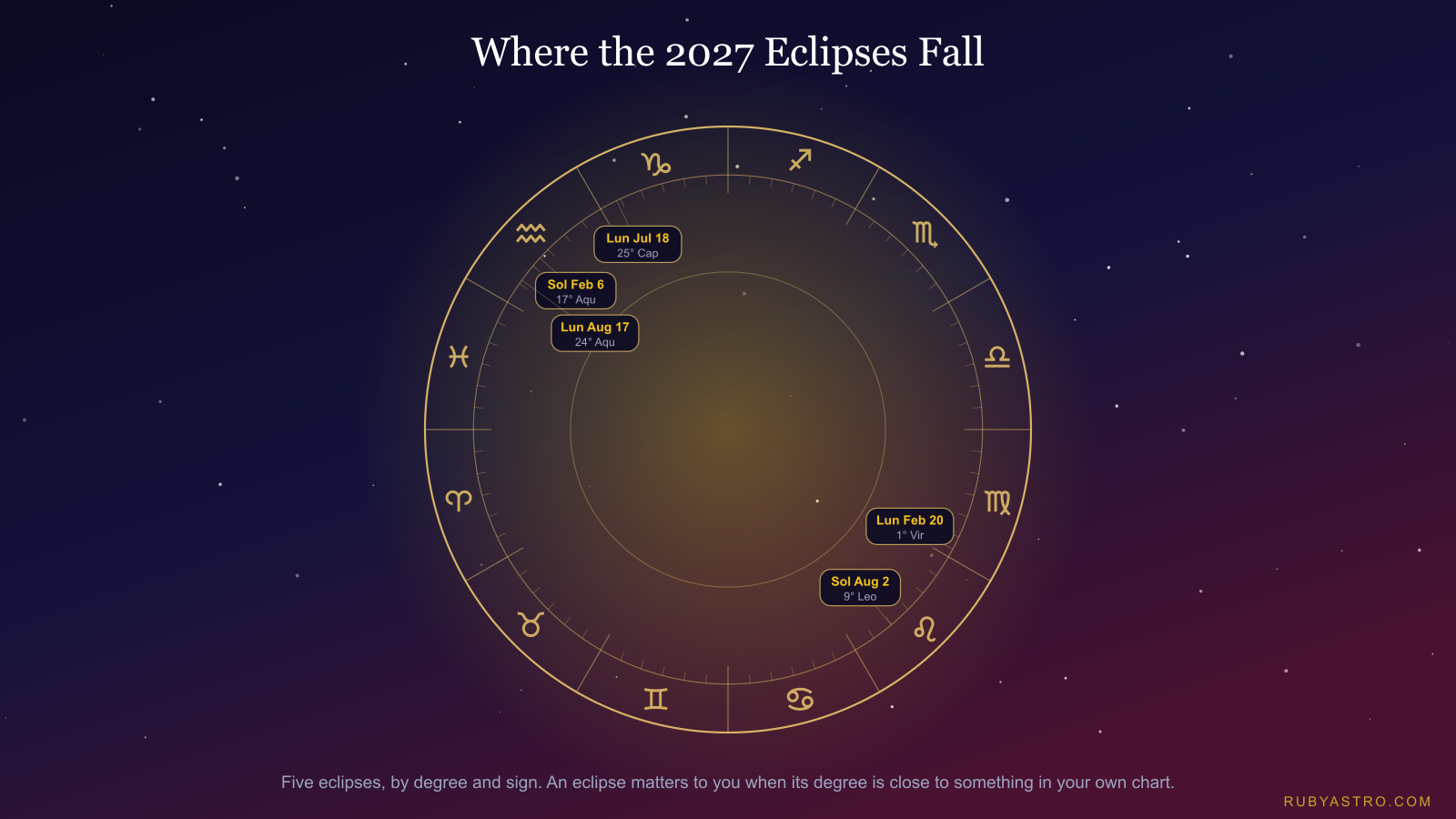
Where the five eclipses of 2027 fall around the wheel. An eclipse matters to you when its degree is close to something in your own chart.
The short answerThere are five eclipses in 2027, in two seasons. February brings an annular solar eclipse and a penumbral lunar eclipse; July and August bring three more, including a total solar eclipse at 9°55' Leo with the longest totality over land of any eclipse this century. Exact dates and degrees are below, in US Eastern.
All five 2027 eclipses, with the degree of the Sun or Moon at maximum
Date and time
Type
Degree
Where it is visible
February 6, 2027, 10:59 AM ET
Solar, annular
17°38' Aquarius
Parts of South America, Antarctica and the south Atlantic
February 20, 2027, 6:12 PM ET
Lunar, penumbral
1°59' Virgo
Much of the night side of Earth
July 18, 2027, 12:02 PM ET
Lunar, penumbral
25°58' Capricorn
Much of the night side of Earth
August 2, 2027, 6:06 AM ET
Solar, total
9°55' Leo
North Africa, southern Spain and the Middle East
August 17, 2027, 3:13 AM ET
Lunar, penumbral
24°04' Aquarius
Much of the night side of Earth
The August total eclipse
The one people will still be talking about. On August 2, 2027, 6:06 AM ET the Moon covers the Sun completely at 9°55' Leo, and the path of totality runs across North Africa, the southern tip of Spain and on into the Middle East. Totality lasts over six minutes at its longest point, which will not be beaten over land until the next century.
It is not visible from the United States. The next total solar eclipse that crosses the country is in 2045. But eclipse astrology works on the degree, not the view: what matters is whether nine or ten degrees of Leo is close to something in your chart.
How to tell if an eclipse is yours
Most eclipses pass over most people without much happening, and the honest version of this is not the version that gets shared. An eclipse matters to you when its degree falls within roughly two degrees of a planet or an angle in your own chart. That is a narrow target, which is why a given person might have one significant eclipse in three years rather than five in one.
Find the degrees in the table above: 17 and 1, then 25, 9 and 24.
Compare them against the degrees of your own planets, and especially your rising sign and midheaven, which need a birth time.
Anything within about two degrees, in any sign, is worth noting. Same sign is strongest, opposite sign next.
If nothing in your chart is close, this is a year where the eclipses are other people's news.
Eclipses are not omensThe tradition that treats an eclipse as a warning comes from a time when an unexpected darkening of the Sun was genuinely alarming. What the better modern practice observes is narrower: eclipses tend to accelerate something already in motion, and they tend to do it in the part of the chart they land in. They do not introduce events out of nowhere.
The February season
Two eclipses, a fortnight apart, on opposite sides of the wheel. The annular solar eclipse on February 6, 2027, 10:59 AM ET falls at 17°38' Aquarius; the penumbral lunar eclipse on February 20, 2027, 6:12 PM ET falls at 1°59' Virgo. An annular eclipse is one where the Moon is too far from Earth to cover the Sun completely, so a ring of light stays visible around it.
Eclipse seasons work in pairs like this because they need the Sun near one of the two points where the Moon's tilted orbit crosses Earth's. That alignment lasts a few weeks and comes round roughly every six months, which is why eclipses always arrive in clusters rather than singly.
Why there are exactly five
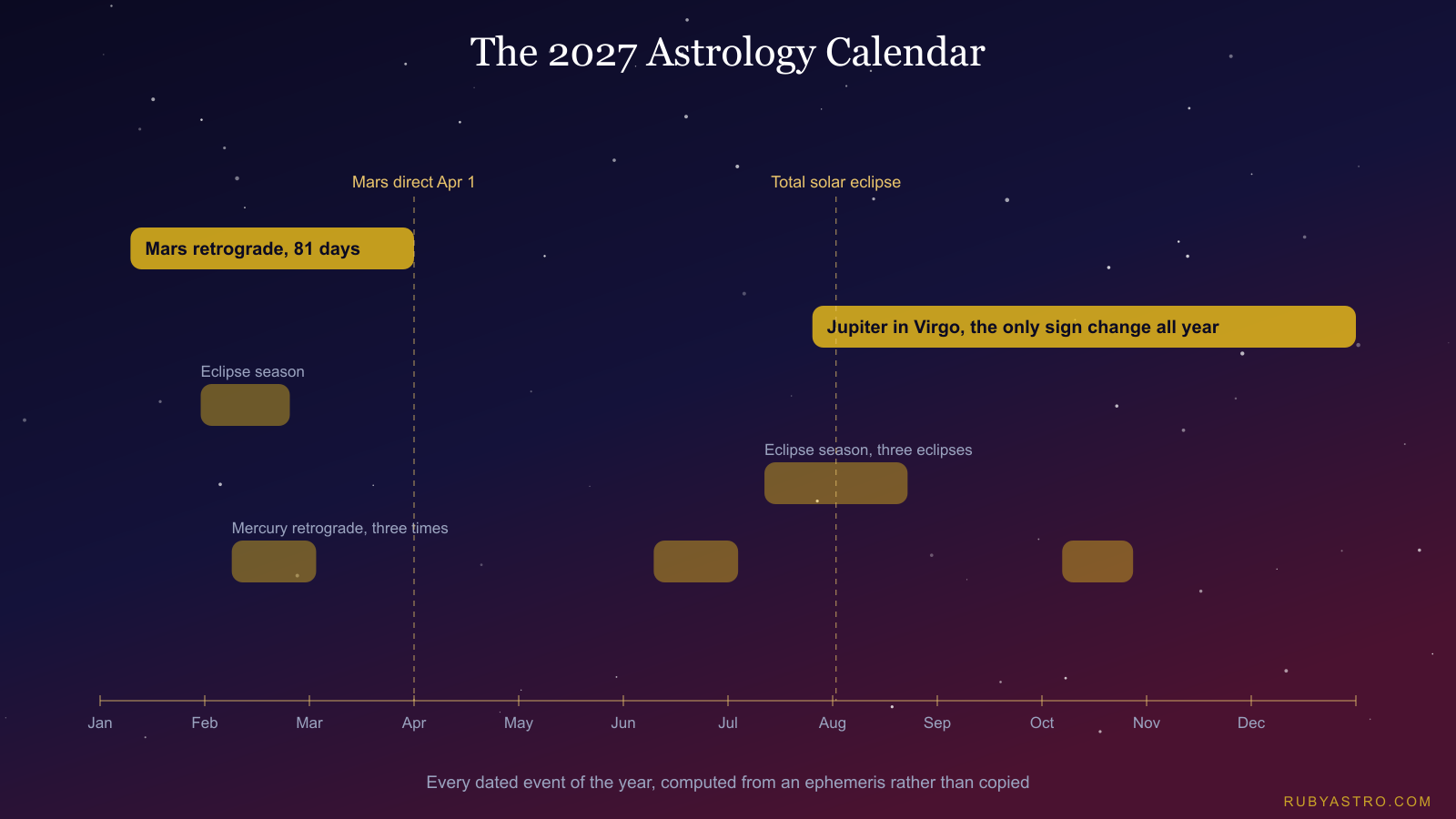
A year has between four and seven eclipses, and five is the common case. Two seasons of two is the minimum; a year gets a fifth when a season is long enough to fit three, which is what happens in 2027 between July and August. The three summer eclipses on Jul 18, Aug 2 and Aug 17 are one season, not three separate events.
The degrees to write down
If you take one thing from this page, take these five numbers and the signs they sit in. They are what makes an eclipse yours or not.
17°38' Aquarius, on February 6, 2027: solar, annular
1°59' Virgo, on February 20, 2027: lunar, penumbral
25°58' Capricorn, on July 18, 2027: lunar, penumbral
9°55' Leo, on August 2, 2027: solar, total
24°04' Aquarius, on August 17, 2027: lunar, penumbral
A solar eclipse tends to mark a beginning and a lunar eclipse a culmination or an ending, which is the same distinction as a new moon and a full moon, turned up. The sign tells you the flavour; the house in your own chart tells you the department.
August 2, 2027, 6:06 AM ET, at 9°55' Leo. The path of totality crosses North Africa, southern Spain and the Middle East.
Is the 2027 total solar eclipse visible from the United States?
No. The next total solar eclipse visible across the United States is in 2045.
Do eclipses affect everyone?
Not meaningfully. An eclipse tends to matter when its degree falls within about two degrees of something in your own chart, which for most people is a rare alignment.
RubyAstro writes about astrology for reflection and self-understanding. Nothing here is medical, legal or financial advice, and none of it is a prediction of events. Read our full disclaimer.
 Astrology Calendar